Webinar
MMM is here. Turn marketing mix modeling into better decisions.

Released:
Prompt-driven campaigns are coming from Google, OpenAI and Meta. Google and Meta still keep a human in the loop. OpenAI’s vision goes much further.
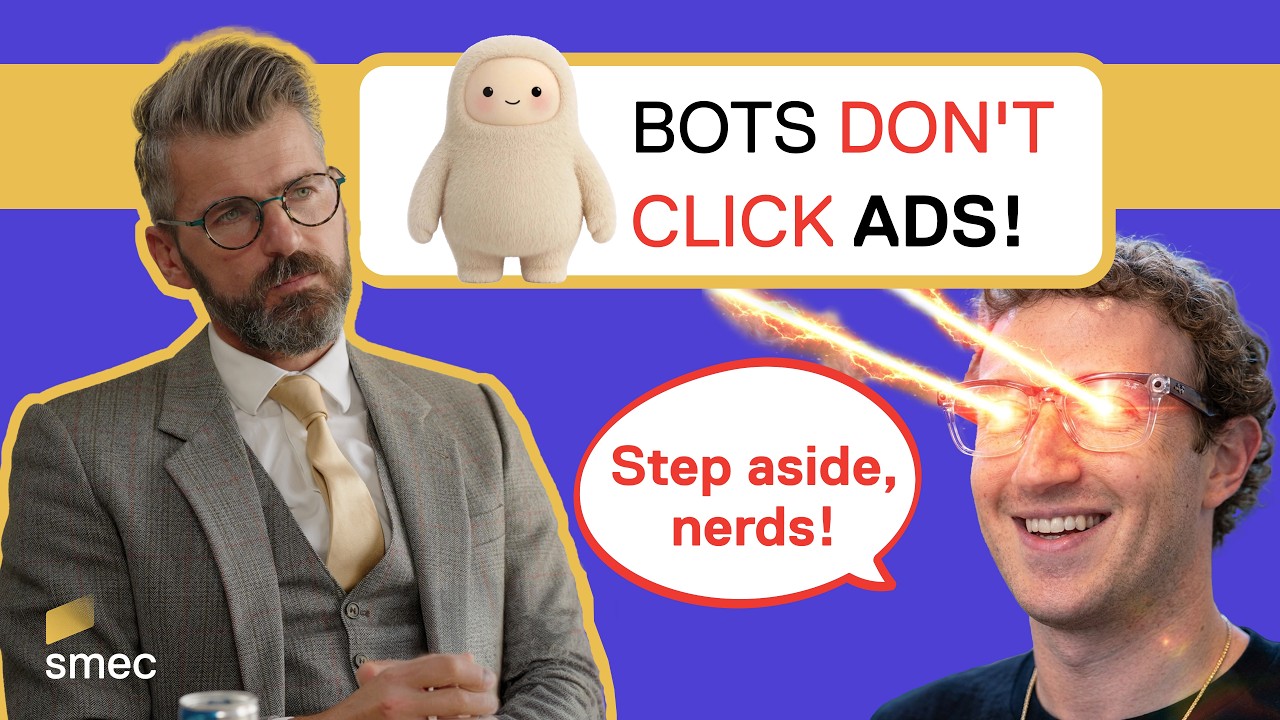
Mike Ryan and Chris Scharmueller compare three very different visions for prompting campaigns, and ask whether campaigns still have a right to exist.
Google has pitched a conversational way to build campaigns since Google Marketing Live 2023. Its latest step is AI Brief, now in closed beta for AI Max. You tell the AI in your own words how you position your brand, which searches you don’t want and what messaging to avoid. The hosts see it as a new control layer on top of automation, with the expert still in the loop.
OpenAI is aiming much further. In a recent interview, Asad Awan, who leads monetization at OpenAI, described campaigns that advertisers prompt into being, with the structure created underneath. His question, “Is campaign an important thing?”, gets a strong reaction here: every control you have sits in the campaign.
So what would a world without campaigns look like? Picture Performance Max taken to the extreme: a budget, a goal, and ads generated on the fly. The hosts argue retailers, agencies and in-house teams won’t accept it, because when performance drops there’s nothing left to diagnose or change.
Meta’s Muse for Small Business, launched in late September, already drafts campaigns from a goal. But nothing publishes or spends without the owner’s approval.
⏱ Timestamps
00:00 - Do campaigns still have a right to exist?
00:41 - Google’s vision for prompting a campaign
05:46 - How AI Brief adds a control layer to AI Max
08:00 - OpenAI’s vision: is a campaign even important?
12:24 - What a world without campaigns would look like
14:38 - Why cutting out the human won’t land
18:24 - Meta Muse for Small Business: still human in the loop
20:30 - Low point of the week
💡 Key Takeaways
Prompting a campaign isn’t a new idea. Google has pitched it since Google Marketing Live 2023. What differs now is how far each platform wants to take it.
Google’s AI Brief lets you guide AI Max on messaging, matching and audience in plain language. It’s in closed beta, starting with AI Max for Search, and Google has named Performance Max and AI Max for Shopping as next.
OpenAI’s monetization lead sees the campaign as a control layer that could be built automatically under a prompt. The “final frontier” is one prompt that handles the rest.
Campaigns aren’t low-level units. They’re where your controls sit. Take them away and you lose the reference points you need when something goes wrong.
Prompting sounds easy, but it’s hard to know what to change in a prompt when results drop.
Meta’s Muse for Small Business drafts campaigns from a goal, but nothing publishes or spends without the owner’s approval.
Put prompting to work before Black Friday
Practise now, before peak season. Our free Black Friday prompt email course gives you ready-to-use prompts for checking your Google Ads through last year BFCM so you can plan this year.
👉 Get the Black Friday prompt course
Keeping the Human in the Loop
As ad platforms like OpenAI and Meta push toward a fully automated, campaign-less vision where advertisers simply supply a budget and goal, ecommerce leaders must maintain control layers to protect their business. Features like Google’s AI Briefs demonstrate how prompt-driven AI can empower marketers through guidance rather than eliminating campaign structures entirely. Without human oversight and clear reference points, diagnosing performance drops or guarding brand alignment becomes nearly impossible when algorithms misfire. For ecommerce teams, prompting offers massive leverage when executed as an added guidance layer while keeping expert human judgment in the loop.
00:00:02 - 00:00:11
Mike: Okay, perfect.
00:00:11 - 00:00:41
Mike: Welcome to another episode of Growing Ecommerce. Today we’re going to be talking about prompt-driven campaigns, or if campaigns even have a right to exist anymore. How’s your stuff, Chris?
Chris: Whoa! Hello, sir.
Mike: Hey. Getting cold in here?
Chris: Yeah. Well, what do you have for me today?
Mike: It’s not a new idea, I know, but there’s some momentum behind it.
00:00:41 - 00:01:06
Mike: Yeah, I mean, we could probably trace it back to Google Marketing Live in 2023.
Chris: Yes.
Mike: And sorry, I don’t want to get ahead of myself too fast, but with Google, I’m up and down on them because I just feel like they’re lacking some execution power compared to some of their peers. But Google had this initial sort of vision.
00:01:06 - 00:01:34
Mike: They talked back then about a conversational experience in the Google Ads UI. And the idea is that as you’d be creating a campaign, you would have this combination of things that you’re used to doing: making a campaign and prompting. Like you could provide a statement, sort of a brief about what your business is and does, what you sell…
Chris: Give your landing page, your goals…
Mike: Yeah, some goals, maybe some assets, and that it would pick up the slack and create ad groups appropriately, write all your ad copy, generate additional images, all this kind of stuff. And that was the vision that they presented years ago. Now, they’ve come a long way.
00:01:59 - 00:02:24
Chris: Well, yeah. Have you heard about Ask Advisor? Pfizer? I don’t know. Why are you so critical of Google?
Mike: You know, it’s evolved the strategy. They have Ask Advisor, or the Advisor family, whatever it’s called.
Chris: Yeah.
Mike: And they also have a feature that was announced at Google Marketing Live this year, I believe, and is now in closed beta, called AI Briefs.
Chris: Yes.
Mike: And it is a revision of the concept.
Chris: Yeah.
Mike: But basically, before we jump too much into detail, the idea of prompting a campaign is not new. The vision is out there, from Google to ChatGPT. Maybe we talk about their vision—a quite ambitious one.
Chris: Definitely. Again, very ambitious.
Mike: They’re ambitious people.
Chris: Yes, absolutely.
00:02:53 - 00:03:25
Chris: Scope versus capability, we talked about in the last episode. But in general, Mike, do you see, if executed correctly, if executed the right way—I’m talking from the perspective of ad platforms—could there be an advantage to agencies and in-house teams out there? Is prompting a campaign maybe the right way to go down? What’s your take on it?
00:03:25 - 00:03:59
Mike: I mean, the upside is potentially massive. We’ll talk about AI Briefs in more detail in a second. The way it’s structured now is more focused on alignment, and people have been pretty positive toward this so far. But if you take these more futuristic visions, like from Meta Ads and ChatGPT, which we’ll talk about in a minute, they essentially talk about cutting out all of that work entirely.
00:03:59 - 00:04:20
Chris: Yes, and naturally for a business, that would be very profitable if it works, of course. So the upside, theoretically, is—I don’t know whether to say unbounded, but very large. And it’s just going to be a question of theory versus reality.
Mike: Absolutely. And what do people really want? How much will they accept?
00:04:20 - 00:04:43
Chris: Yeah, no doubt about that. And this is where I see—we were kind of critical of Google in the last episode, but this is where I see Google to be on a better path. Because what I see with Google… By the way, I can still remember to this day when I talked to Shane, a high-level guy at Google who really knows his stuff. Biggest respect for this guy. He knows his stuff. He basically invited the leading agencies of Europe and was talking to us, and he explicitly said, “Look, the vision of Meta is that they want to cut you out.”
Mike: Which sucks. They’re not even hiding it, right?
Chris: No, he’s not.
00:05:05 - 00:05:25
Chris: But Google said, “Look, of course they will fall into credit. Of course they will push their ideas of making you capable to prompt campaigns and cut out all the boring operational stuff, but they want the expert to be in the loop.” That statement was made, I think, one and a half years ago, and to this day I believe them. You literally see it, because now, circling back to the AI Brief, I think it’s not cutting out your control layers. It’s not diminishing them. It just empowers you, ideally, to do things faster, more efficiently.
00:05:25 - 00:05:46
Mike: Yeah. What’s your take on it?
Chris: Would you agree with that? I mean, yes, and I would even say we have to see how it evolves. But for the time being, the way I see it, it’s adding a control layer, in fact. Because right now it’s for search campaigns, and it will be coming out in the future for Performance Max and Shopping campaigns. But the idea here is that Performance Max already has this very broad targeting. It already has the capability to select landing pages, write ads…
00:06:16 - 00:06:40
Mike: So it is very fully automated already. And that’s a layer on top of what could potentially be a much more manual and controlled campaign underneath it. So you add on this layer on top of it. And what AI Brief does in the first place is it helps offer guidance.
Chris: Guidance, yes to that.
Mike: You know, you can tell it things.
00:06:41 - 00:07:03
Mike: It’s as if you had a creative working for you. You would never tell them, “Here’s my website, just take it from there.” You’d offer them a lot more. You’d offer a brief. Yes, that’s why it’s called briefs. You offer them guidance, and you’d say, for example…
00:07:03 - 00:07:32
Mike: “Hey, it’s really important to us that we position ourselves as premium.” And then if you find that your ads are triggering against keywords including the word “cheap” or that there are bargains showing up in your ad copy, that would be very concerning to you. And that is the kind of guidance with AI Briefs. You can give guidance that will offer orientation or alignment to the AI in terms of messaging, matching, targeting, that kind of stuff.
00:07:32 - 00:08:00
Chris: Yes. That’s why I think the AI Brief is supporting the idea of Google, which I really think is seeing the human expert very much in the loop. And I’m with you. It basically gives you the possibility to guardrail these highly automated campaign types. So I think this is a positive thing. From my perspective, rather a negative thing… You know the name Asad Awan?
Mike: Yes, I know him.
Chris: I mean, he leads monetization at OpenAI. So basically I assume he’s running that strategy.
Mike: Probably. Big part of the monetization, right? That’s where the money has to come in. I mean, you want to be this $1 billion ARR ads machinery.
00:08:22 - 00:08:46
Chris: However, what I would love to understand here—it’s pretty clear based on that interview, maybe we can read some quotes from that interview—is that when we talk about prompting campaigns, the vision of ChatGPT is completely different compared to Google’s.
Mike: Yes. It’s much more like Meta’s long-term vision, right?
Chris: Because as far as I understand Google’s roadmap, yes, you prompt a campaign, but it is an additional control layer, and all the entities and artifacts of the Google Ads ecosystem we fell in love with—having a campaign that grew—it’s still there.
Mike: Yeah, exactly. Shed some light on the vision of ChatGPT.
00:09:32 - 00:10:02
Mike: Well, it seems different. In an interview with Eric Switzer, they shared an alternative view here. They talked about prompt-driven campaigns—this idea that you can prompt a campaign into existence. And the first part sounds an awful lot like Google’s conversational experience or something kind of like AI Briefs. They talk about giving a brief, which of course reminds us of AI Briefs, and having some optional text, a landing page, structured data like a feed. So that’s all stuff where I can kind of say, “Okay, that sounds fair. I understand where you’re heading with that.” And it will draft a campaign or something like that.
00:10:02 - 00:10:34
Mike: But where he quickly goes with this is that he sees the campaign entity… he asks, “Is campaign an important thing?”
Chris: The question alone! It’s getting cold again.
Mike: “Is campaign an important thing as an entity?” And I think most people listening are probably saying, “Yeah, campaigns are marketing to a huge extent.” They’re marketing campaigns. Campaign is the engine of Google Ads, of Meta. But his view on this is that you could give one prompt and get a daily summary in a future state. And this reminds me a lot—again, we said this sounds like Meta’s vision—Mark Zuckerberg has said that basically you should give him a goal and then he’ll give you some KPIs, and you don’t have to do anything. No one has to do anything.
Chris: “Give me the budget and the goal, and we will do the rest for you.”
Mike: Exactly.
00:11:13 - 00:11:31
Chris: Just to be clear, because I think nuances matter. He literally said—I mean, the question alone… By the way, I love to finally be really disruptive in that universe, but I don’t know if this is landing the right way. And I don’t know how many people read this in the first place, but we talk about it. So, “Is campaign an important thing?” Yes, it’s there for some control…
Mike: Hold on, dude! It’s not there for “some control.” Every control layer you have is cumulated in this campaign entity! Exactly.
Chris: This creates some emotions, but just to express that. Under the hood, it could get automatically created. Because I do think having that ability to not have to manage these very low-level units… maybe there is a final future for us.
00:11:58 - 00:12:24
Mike: Low-level unit? Yeah, it’s not a low-level unit, dude!
Chris: Yeah, totally. You’re right, it’s not. It’s not like we’re talking about down to the keyword level or something. Or even insane like having the ability to not have to… yes, this is a strange phrasing, but is it such a privilege to not have to manage campaigns? I’m not sure about that.
Mike: It’s certainly not a privilege.
00:12:24 - 00:12:59
Mike: I’m trying to even imagine what a campaign-less world would look like. And I mean, it’s kind of like Performance Max taken to the ultimate degree. Performance Max wants to automate as many functions and jobs of the campaign as possible. It has automated placements, automated creatives, automated targeting, increasingly automated budget allocation…
Chris: They’re going in that direction, certainly the allocation.
Mike: And they even want to propose the budget for you.
Chris: But the sliders are there now.
Mike: Yeah, don’t forget our sliders! But I guess what he’s proposing is this kind of amoeba-like thing where you’d have a budget and you’d have a goal, and everything else is just latency.
Chris: Yes. Like the creative will materialize in the instant of the ad. You don’t need to pre-build ads, the ad will just generate. When we talk about generative AI and starting with a prompt, that’s where this would potentially go.
00:13:55 - 00:14:14
Chris: Look, I think that way of framing that vision lands way better with me. But I’m just saying, is OpenAI in the position in the first place to talk about that vision, given where they are right now? I’m not kidding, because look, again, I don’t know how many people are reading this interview and how many people are into this, but if you look at where they are right now and then he’s throwing out that vision…
00:14:15 - 00:14:38
Chris: I think it’s creating insecurity for a lot of retailers, because what does that mean? The step from where they are right now to having a campaign-less vision where you just prompt and everything will be done for you—man, we’re talking about years. It’s like Star Trek compared to what they’re doing right now. It’s completely the wrong way.
00:14:38 - 00:15:06
Mike: I hear you. To play devil’s advocate in a way, this is what we always would have expected from OpenAI. Because in a way, we see that they’re doing ad groups and just very much copying Google. That’s even Google from ten years ago, with these very limited creative units and stuff like that. So to play devil’s advocate, maybe this is more what you would expect from an AI-native app. It would be at least disruptive, because right now they are not disruptive in that space.
00:15:06 - 00:15:35
Chris: No. But anyway, I think even having the goal to really be this disruptive player in the ad space—which they have to be, because otherwise I don’t see them gaining any significant market share—still, this idea of removing any control layer is not going to land, I promise you that.
Mike: Yeah.
Chris: I promise you that.
00:15:46 - 00:16:16
Mike: To quote the great Frederick Vallaeys…
Chris: Please do the quote for him!
Mike: Oh yeah, I can’t remember the verbatim quote. But Fred Vallaeys, an early Googler and now in the third-party adtech space, wrote years back based on his observations of Google’s tech from having worked there. He said that Google always tries very hard to automate. Then they realize that they have to roll back because either the market rejects it or the technology wasn’t as capable as expected. But then you know they’re going to try again. The next move happens again, and in the end it’s this kind of two steps forward, one step back, but they do trend forward on automation.
00:16:47 - 00:17:07
Chris: I fully hear that. However, if they had looked at Google and how they do it, I think that vision Mark Zuckerberg is aiming at—“just give me the money, and I will do the rest for you”—I think it’s not going to work. There will be no adoption for that idea, because there are so many parties fundamentally against it: all the agencies, all the freelancers, all the true experts, and of course, first and foremost, the online retailers. They want to have this control layer.
Mike: Yeah, it triggers me.
00:17:07 - 00:17:35
Chris: If things are not going well, it’s so hard to diagnose. We talk about black boxes. What entities are you referring to? How do you get down to what happened? How do you change something?
Mike: Because I guess the idea would be like, “Oh, it destroyed my business yesterday. Whoops! Where, and what can I do about it?”
Chris: “Okay, so here’s my brief again. And by the way, please don’t fuck up my business.”
00:18:00 - 00:18:24
Mike: You know, you bring up a great point, because the prompt, as powerful as it sounds because it feels conversational, it’s hard to prompt in a way that’s easy to understand why it didn’t learn right or what you have to change. It’s back to the sliders idea.
00:18:24 - 00:18:58
Mike: Before we wrap this topic up, we’ve left out one player, which is Meta themselves. Last week we talked about Meta Muse, and it was actually already live at the time—I think it went live in late September. They have something called Muse for SMEs. And as prophesied—no surprise here—they want businesses to use Muse for ads management. So this is also heavily stepping in the direction of prompt-driven campaigns or prompt-driven digital marketing.
00:18:58 - 00:19:23
Mike: So it’s very similar. They say that basically this can draft your campaigns based on what you tell it. And it can also draft ads or posts, it can do analytics. So that reminds me of Ask Advisor. This is the direction that they’re going in. What I will say is that it’s still human-in-the-loop.
Chris: Yes, that’s the point! Important.
Mike: That’s the point.
00:19:23 - 00:19:46
Mike: Again, I think the idea of prompting a campaign, executed the right way, can be massive leverage for everyone. Executed the wrong way, in terms of just cutting out the human in the loop… I want to quote another great guy I know, his name is Mike Ryan.
Chris: “How sure am I that algorithms are strategic in what they do? All the things we know and see is they are not strategic.”
Mike: Yeah. And of course then you could say, “Yes, that’s the reason why you have to prompt it.” But yes, the prompt itself only makes sense if I have some control layer still and reference points I can look at if something goes wrong.
00:20:09 - 00:20:30
Chris: So I’m just not a fan at all of this vision. So Asad Awan, if you’re listening to us, I think it’s not a good idea. By the way, it won’t land with the market.
Mike: No, at least not yet. He talks about it as their final frontier or something like that, so we’ll find out. We’ll see how long it takes and if people are ready for these ideas.
00:20:30 - 00:20:54
Mike: Anything else, or…?
Chris: I’m just kind of reaching around in my brain looking for something negative…
Mike: Yes, of course, negative or low point.
Chris: Low point still is there. Mark would kick… by the way, I think even if we fought him at the same time, I think he would still kick our ass.
Mike: A lower low point than last time!
00:20:54 - 00:21:15
Mike: Hold on, Chris. I thought we would need a third guy at least. I have to tell you, I get so many emails every week, every day, from people or AI trying to place guests on this podcast.
Chris: Which is funny, because we actually haven’t had a guest on this podcast in a long time.
Mike: That’s right. Mark Zuckerberg! So why are they even pitching in the first place?
00:21:15 - 00:21:37
Mike: And yeah, I loved it. It was like, “Your podcast is so empowering!” And it’s like, no it’s not, it’s depressing! This is our depression…
Chris: I know you never listened to the podcast if you called it empowering. No one who listened to the podcast would ever call it empowering if they tried.
Mike: “Your podcast is so depressing and always ends on a down note, I bet.”
Chris: Oh my god, did they actually listen?
Mike: Yes!
00:21:55 - 00:22:41
Mike: Well, look, everything will be okay anyway. Everything’s gonna be fine.
Chris: Yes, of course. I’m an optimist, actually.
Mike: I’m Optimus Prime!
Chris: Thanks for the dad jokes. We can tell you’re a dad. And on a low point…
Mike: Yeah, definitely a low point. All right, this has been another episode of Growing Ecommerce, brought to you as always by Smarter Ecommerce. You can learn more at smarter-ecommerce.com. And as always, we really appreciate those YouTube comments and likes.
Chris: September was an insane month. Thanks for that!
Mike: Yes, I hope that at the end of October we’ll say the same. It was our biggest month ever, so that’s thanks to the support from people like you. Thank you so much.
Chris: All right, man, I have to shoot. I have a sales sparring session.