Subscribe to join thousands of other ecommerce experts
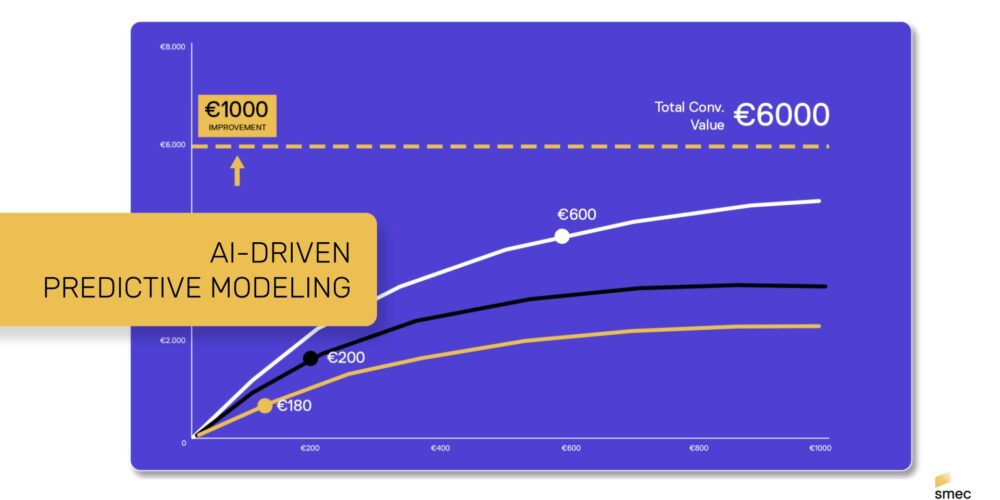
Your ‘best’ campaign may be your worst investment because a high Average ROAS frequently masks a negative Marginal ROAS, meaning the last dollars of your budget are actually losing money even if the overall campaign average looks profitable. While management often sets an overall ROAS target as a benchmark for historical efficiency, the true steering mechanism for the Performance Max (PMax) algorithm is understanding where different ROAS targets yield additional marginal results at the campaign level.
Table of Contents
The efficiency myth: Why averages fail the PMax algorithm?
Average ROAS is a retrospective metric that ignores the reality of incremental growth. In the context of PMax, ROAS serves as the primary steering mechanism; it tells the algorithm how aggressively to bid for the next available auction. If you only monitor the average, you remain blind to the “Efficiency Trap,” where your high-performing brand or retargeting traffic props up the numbers while the algorithm wastes budget on unprofitable, low-intent queries.
Therefore, as you increase your budget, the PMax algorithm is forced to reach for less relevant audiences. Consequently, the marginal return on that extra spend often plummets below your break-even point, even if the total campaign average remains above your target.
The Risks of Average-Based Steering
- Unprofitable Scaling: Increasing spend on a campaign with a high average often leads to diminishing marginal returns.
- Algorithmic Misalignment: Static targets prevent the AI from finding the “Profit Peak” where incremental spend matches incremental gain.
- Invisible Waste: You may be paying for conversions that would have occurred naturally, artificially inflating the average while delivering zero incremental value.
What are the dangers of relying solely on Google’s budget and tROAS?
Google’s budget & tROAS optimization has two fundamental limitations:
1. Single-campaign view: Google optimizes each campaign in isolation. If Campaign A could deliver better returns with more budget, Google won’t automatically shift budget from Campaign B.
2. No business context: Google knows revenue but not margin, stock levels, or strategic priorities. A 100 product with 10% margin and a 100 product with 50% margin look identical to Google.
How to take control: The smec approach to incremental growth
At smec, we have analyzed literally thousands of PMax campaigns to understand exactly how the algorithm reacts to budget and bid changes. Our research confirms that the “Digital Divide” in retail is defined by those who use data to govern the AI versus those who let it dictate their growth.
To solve this, we developed a specific steering layer within the smec Campaign Orchestrator: AI-powered tROAS and Budget Recommendations. smec‘s AI-powered tROAS and budget recommendations is a smart feature in our Campaign Orchestrator that suggests the best way to distribute your budget across all your campaigns. Forget looking at campaigns one by one. Our system analyzes the bigger picture, spotting which campaigns have room to grow and which are lagging. It then recommends shifting your budget to boost profitability and overall efficiency, all tied to your business goals.
Put your budget where the growth is. Knowing where to invest your next dollar is one of the biggest headaches in PPC, especially when budgets are tight. Our smart budget allocation feature takes the guesswork out of the equation.
It’s simple: when your campaigns are constrained by a limited overall budget, our system proactively finds the smartest way to use your spend. It identifies which of your campaigns can deliver better results with more investment and automatically suggests shifts to fuel those winners.
This prevents wasting money on campaigns that are going nowhere and ensures your ad spend is always deployed for maximum impact. It’s the perfect tool for when you’re pressured by budget limitations and need to make every dollar work harder.
smec’s approach
- Optimizes across your entire campaign portfolio, directing budget where it delivers the greatest global impact
- Reacts to segment shifts — when products move between Dynamic Segments, the AI adjusts recommendations accordingly
- Responds to market dynamics like seasonality, not just historical patterns
| Steering Metric | Strategic Role | Algorithmic Impact |
|---|---|---|
| Average ROAS | Historical Reporting | Passive; masks unprofitable scaling and waste. |
| Marginal ROAS | Growth Steering | Active; identifies the exact point of diminishing returns. |
| smec’s AI-powered tROAS and Budget Recommendations | Strategic Orchestration | Optimized; directs budget to the next most profitable euro. |
How to implement Marginal ROI Steering?
To move from legacy reporting to high-performance orchestration, PPC Managers must shift their focus toward incremental yield. While the concept of marginality is straightforward, the execution differs significantly depending on whether you are relying on manual guesswork or data-driven precision.
The Manual Path: Steering by Estimation
Implementing marginal logic manually is possible, but it is often labor-intensive and based on historical snapshots rather than real-time algorithmic behavior.
- Audit the Marginal Curve: You must manually identify which campaigns are “oversaturated” by looking for points where the last 10% of spend delivered sub-par results. This often requires complex data exports and pivot tables to visualize diminishing returns.
- Reallocate for Incrementality: You shift budget away from campaigns with high averages but low marginal returns toward those with perceived untapped potential. Without live modeling, this is essentially an educated guess on where the next dollar might perform better.
- Govern the Algorithm: Instead of a flat account-wide target, you manually set different ROAS targets at the campaign level. This requires constant monitoring and manual adjustments to account for shifting marginal yields.
The smec Path: Scientific Orchestration
smec transforms marginal steering from a guessing game into a scientific process. By analyzing thousands of PMax campaigns, we have built the infrastructure to automate incremental growth.
- Define High-Level Objectives: You set your overall tROAS and budget goals within the platform, aligning the software with your management’s top-line requirements.
- Apply AI-Powered Recommendations: Use smec Campaign Orchestrator and its tROAS and Budget Recommendations feature. Our predictive AI identifies the exact “Profit Peak” for every PMax and Standard Shopping campaign, shifting budget to where the incremental yield is highest based on real-time data.
- Automated Strategic Growth: Sit back and let the AI steer your campaigns. The system continuously recalibrates your bids to give you that extra incremental growth.
| Approach | Method | Accuracy |
|---|---|---|
| Manual Without smec | Manual data exports and heuristic-based estimation. | Low; relies on historical “guesswork” and static snapshots. |
| With smec | AI-driven predictive modeling and scientific marginal analysis. | High; based on real-time data from thousands of analyzed campaigns. |
to give you that extra incremental growth
Outlook: The Industry in 2026
We predict that by 2026, relying solely on Average ROAS will put retailers at a severe competitive disadvantage. As automated auctions become more expensive, organizations that fail to adopt marginal steering and automated budget recommendation engines will likely see their margins eroded by inefficient scaling.
The role of the PPC Manager is evolving from a tactical executor into a Strategic Orchestrator. By focusing on Marginal ROAS and leveraging the scientific precision of the smec Campaign Orchestrator, you move beyond observing the “Black Box” and begin directing a high-precision growth engine that ensures every dollar spent contributes to your actual bottom line.
Don’t let the 2026 shift catch you off guard. Move beyond the ‘Black Box’ today and start steering your growth with scientific precision—book your demo now.