Subscribe to join thousands of other ecommerce experts
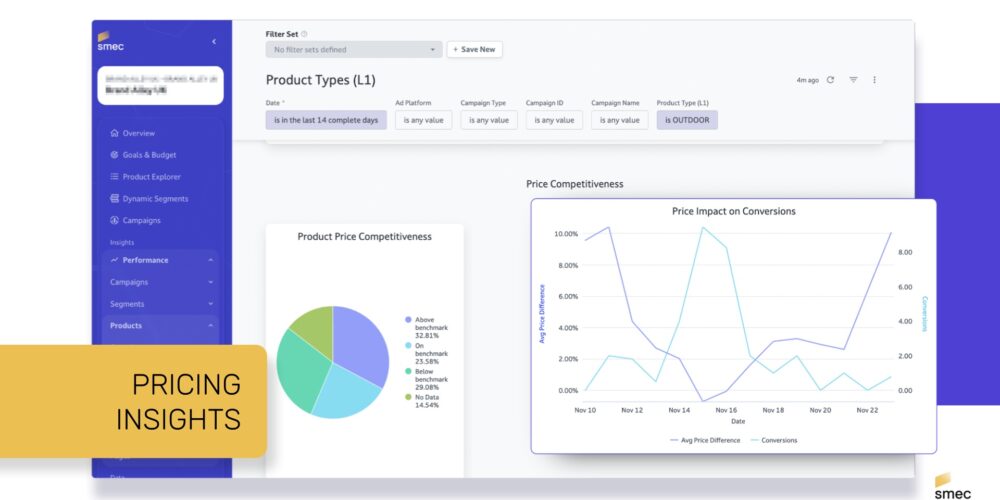
Price Competitiveness Insights is a feature set within the smec Campaign Orchestrator designed for PPC Managers that benchmarks product pricing against market averages to optimize Performance Max efficiency. It enables advertisers to automate Dynamic Segments based on real-time price fluctuations, ensuring budget is allocated to products with the highest probability of conversion.
Table of Contents
The Pricing Challenge in PPC
Pricing is a primary performance driver in e-commerce. Even with optimized PMax structures and high-quality creative assets, performance suffers if products are priced out of sync with the market.
- High Prices: Conversion rates typically decline.
- Low Prices: Volume grows, often at the expense of profit margins.
- Lack of Data: Without visibility into competitor pricing, optimization relies on guesswork.
To address this, smec has introduced two new capabilities within the Campaign Orchestrator: Price Competitiveness Insights and Advanced Price Filters. These features transform pricing data into Actionable Insights and automated control.
Feature 1: Price Competitiveness Insights
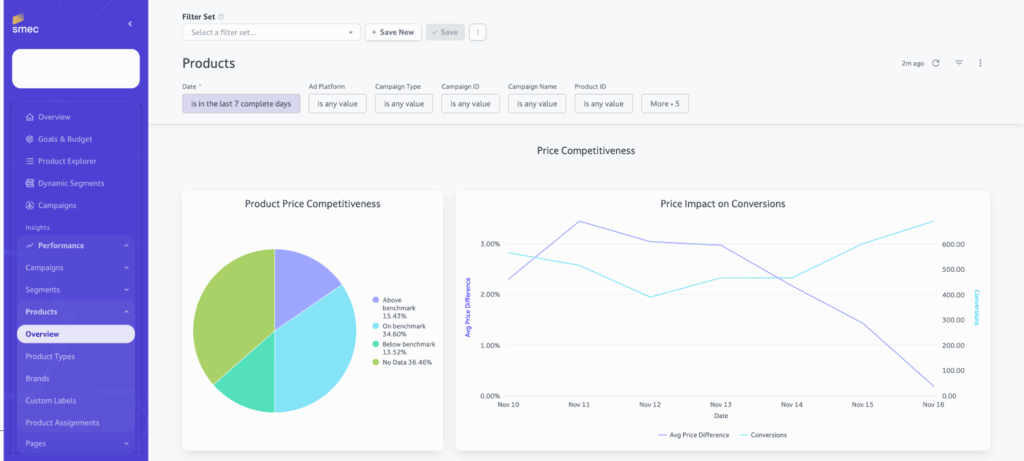
This feature provides transparency into the PMax “black box” by benchmarking specific products against the market11. It replaces manual research with instant data availability.
- Below Market Average: Products priced lower than competitors (typically strong converters).
- At Market Level: Products with stable performance.
- Above Competitors: Products likely to struggle with efficiency in paid channels.
The Insight: This data explains performance shifts that often appear random. A sudden drop in conversions may not indicate a broken campaign, but rather a competitor lowering their price. This visibility allows PPC Managers to correlate price changes directly with conversion rate fluctuations.
Feature 2: Improved Price Filters
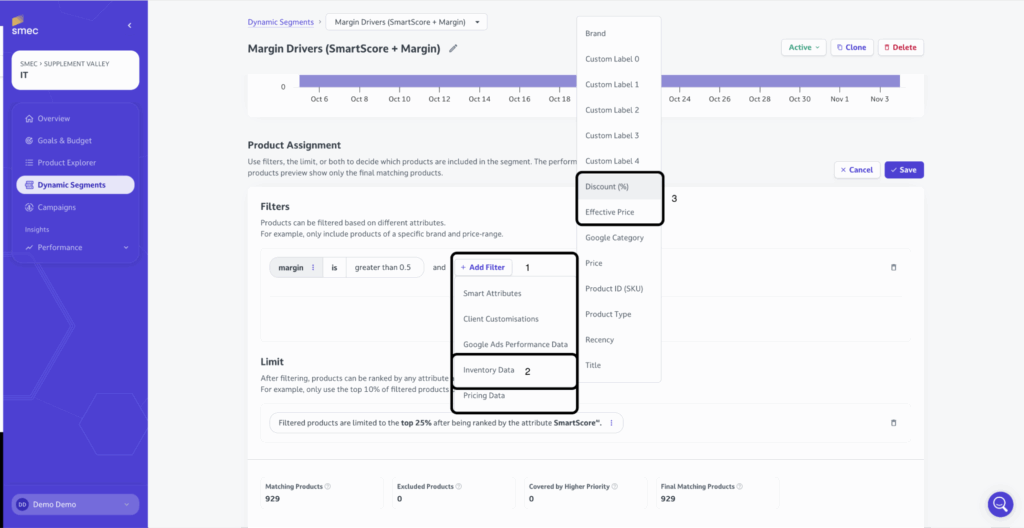
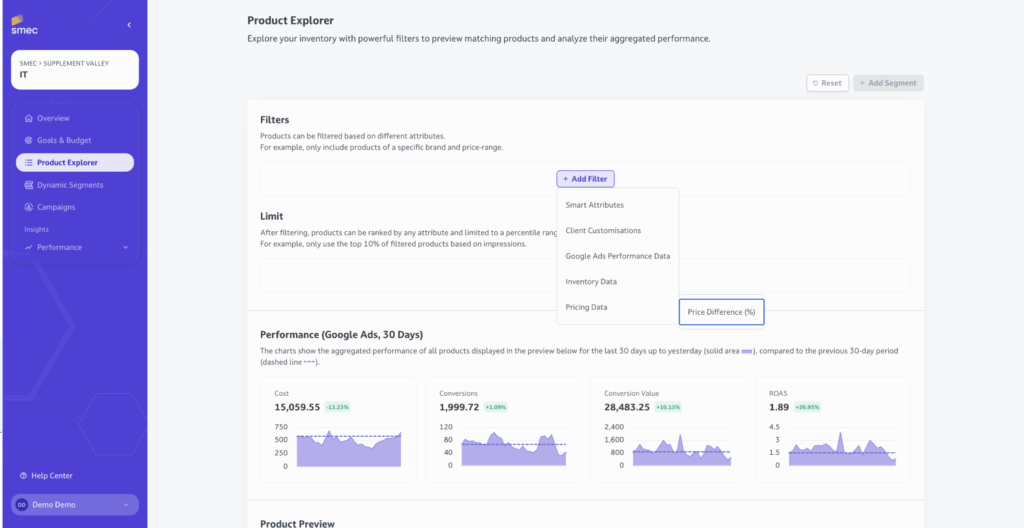
Product Explorer with Pricing Data filter
While insights provide understanding, filters enable action. The updated Price Filters allow users to translate pricing data into strategic Dynamic Segments.
1. Price Difference
- Definition: Groups products based on their deviation from the market benchmark (Below, At, or Above).
- Use Case: Create a “High-Potential” segment for under-market products to capture cheap conversions, or an “Efficiency” segment to limit spend on overpriced items.
2. Effective Price
- Definition: Identifies items currently on sale or temporarily reduced.
- Use Case: Automatically fuel promotion-led campaigns or seasonal pushes without manual intervention.
3. Discount
- Definition: Segments products based on specific discount percentage thresholds.
- Use Case: Isolate products for clearance sales, end-of-season runs, or tactical acquisition bursts.
Automating Strategy with smec Campaign Orchestrator
The smec Campaign Orchestrator unifies these insights with automation to ensure Better Business Results. The system moves beyond static lists to create a living, breathing PPC structure.
The Automation Mechanism
- Dynamic Segmentation: Products can be grouped based on pricing, margins, stock, SmartScoreAI and much more.
- Daily Updates: As prices change (e.g., a competitor lowers their price or a sale launches), products shift between segments automatically.
Budget Allocation: The system directs spend toward competitively priced inventory and away from low-conversion probability items.
Strategic Benefits
| Feature | Benefit | Business Impact |
| Automated Segmentation | Eliminates manual feed reviews. | Saves time and reduces operational error. |
| Market Alignment | Campaigns react to competitor moves instantly. | Protects market share and efficiency. |
| Margin Protection | Prevents overspending on overpriced items. | Increases overall account profitability (POAS). |
Summary
In competitive verticals like Fashion, Electronics, and Home & Living, pricing shifts faster than manual campaign structures can adapt. Price Competitiveness Insights provide clarity, while Price Filters provide the mechanism to act.By integrating these features into the smec Campaign Orchestrator, PPC Managers gain more control over their strategy, ensuring that Performance Max automation is guided by business-critical data rather than generic algorithms.
Frequently Asked Questions
The smec Campaign Orchestrator updates data daily. Dynamic Segments are refreshed automatically based on live data, meaning if a competitor changes their price or a new promotion launches, your products will move into the appropriate segment/campaign immediately without manual intervention.
Yes. Using the Effective Price filter, you can identify and segment items that are currently reduced or on sale. This allows you to automatically fuel promotion-led campaigns or seasonal pushes without needing to manually restructure your campaigns.
While Google provides some pricing benchmarks, the smec Campaign Orchestrator focuses on Actionable Insights and control. We not only show you if you are priced above or below the market, but we also allow you to create Dynamic Segments based on this data to actively steer your ad spend, whereas standard reporting often requires manual implementation to act on the data.
If a product’s price rises significantly above the market average, it can be automatically moved into an “Efficiency” or “Low Priority” segment using the Price Difference filter. This prevents the PMax algorithm from overspending on products that have a lower probability of conversion due to pricing disadvantages.
No. Price Competitiveness Insights and filters eliminate the need for manual research and external spreadsheets. The platform integrates this data directly, allowing you to build rules that function automatically as market conditions change.