Subscribe to join thousands of other ecommerce experts
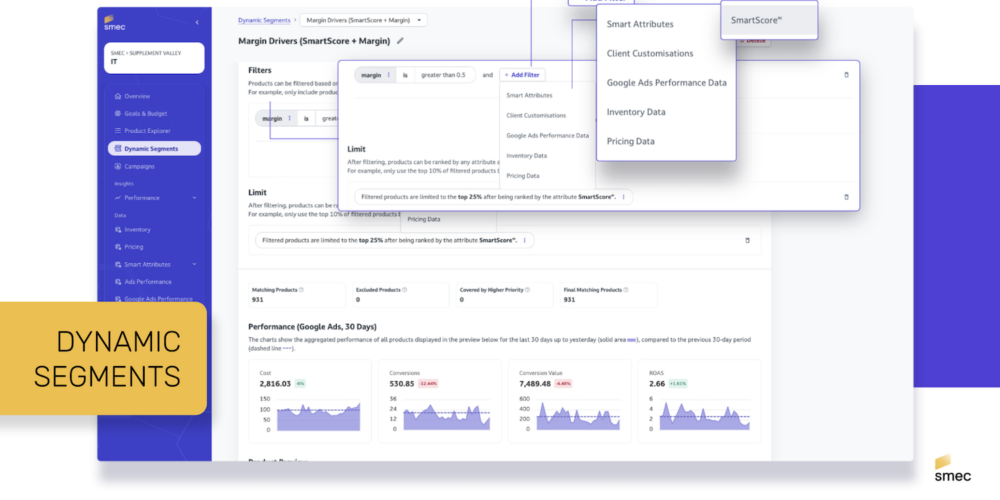
Dynamic Segments is a strategic product-clustering feature, developed by Smarter Ecommerce (smec) that allows retailers to group products based on multi-dimensional business data rather than static attributes. By combining metrics like real-time price competitiveness, margin, and performance data, Dynamic Segments enable the automatic steering of Performance Max (PMax) campaigns toward specific business outcomes like Profit on Ad Spend (POAS) or high-volume revenue growth.
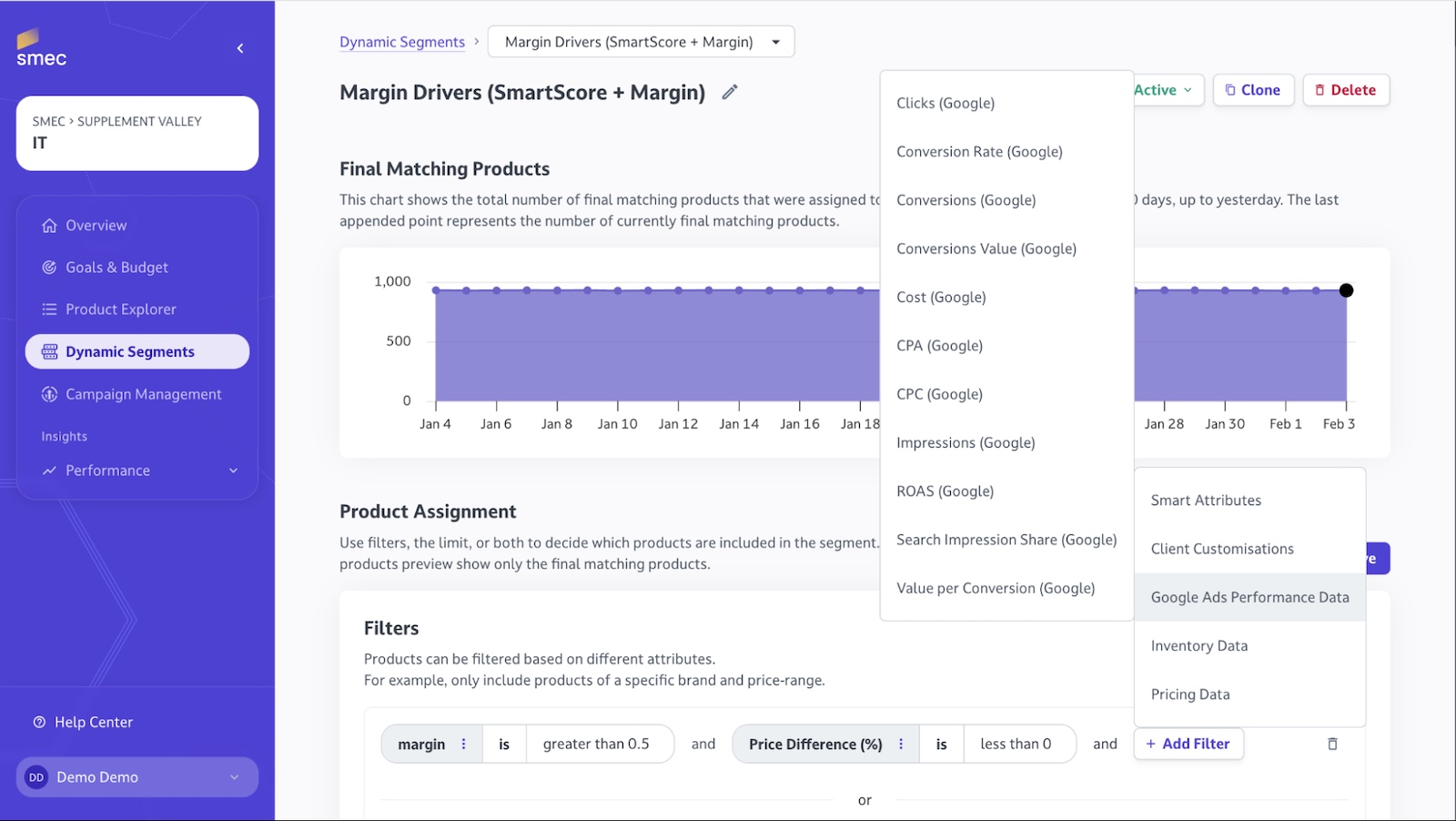
Table of Contents
The End of One-Dimensional Segmentation: Beyond Standard Custom Labels
Standard Google Ads product grouping often relies on static custom labels (e.g., “Best Sellers” or “Sale Items”) that require manual updates and offer limited context. Consequently, many retailers fall into the “1D Trap”—optimizing for a single metric like ROAS while ignoring the broader business reality of fluctuating stock and varying margins.
Dynamic Segments provide a strategic control layer that translates complex business logic into signals Google’s AI can prioritize.
By moving away from static labels, PPC Managers can ensure that their most important products—not just their most clicked products—receive the necessary visibility. This shift is critical as we enter the era of “Agentic Commerce,” where AI search engines and shopping assistants prioritize products backed by rich, structured data.
The Problem with Passive Campaign Management
Standard PMax and Standard Shopping setups often fail because retailers do not actively guide the algorithm toward their company goals. This leads to three primary inefficiencies:
- Misaligned Spend: Budget is often diverted to low-margin items that have high click-through rates but low bottom-line impact.
- Hero/Zombie Inefficiency: “Hero” products dominate the budget, leaving high-potential new arrivals or seasonal stock in a “zombie product” graveyard.
- Strategic Disconnect: The PPC Manager’s tactics become disconnected from the CMO’s goals because the platform is optimizing for platform metrics instead of business outcomes.
How Dynamic Segments Work: The smec Approach
The smec Campaign Orchestrator introduces Dynamic Segments to bridge the gap between your product feed and your business goals. Therefore, the process is not just about automation—it is about strategic orchestration.
| Feature | Static Custom Labels | smec Dynamic Segments |
|---|---|---|
| Data Refresh | Manual or daily feed uploads | Real-time, multi-source integration |
| Complexity | 1 attributes (e.g., Brand or category) | Unlimited combinations (e.g., high margin + price competitiveness + high stock level) |
| Automation | Manual effort to adjust and move products to different campaigns | Automated movement between campaigns based on logic |
| Visibility | Limited to Google’s basic reporting | Deep, product and segment-level insights and competitive data |
Use Case: The Shade Station Success Story
A prime example of this strategy in action is the case of Shade Station, a Google Ads Impact Award Finalist in 2025. By moving away from a traditional PMax structure and implementing a strategy centered on strategic product grouping, Shade Station achieved significant growth, while expanding internationally.
Through the use of Dynamic Segment and smec technology, they were able to align their ad spend with their most valuable inventory, proving that strategic control in PMax is the primary driver of ROI in modern ecommerce.
How to Use Dynamic Segments inside Campaign Orchestrator
Creating Dynamic Segments inside Campaign Orchestrator is super easy to do:
How to Implement Strategic Segmentation
- Integrate first-party data, including margin data, AOV, CLV, stock levels and more, into the Campaign Orchestrator.
- Create Dynamic Segments based on your primary business goal (e.g., “Push high-margin items that are also priced below your competitors”).
- Connect the segment to any PMax or Standard Shopping campaign, with a specific tROAS and budget.
Want to see what it looks like? Try out our interactive demo.
Outlook: The Industry in 2026
We predict that in 2026, the competitive gap will widen significantly between retailers who rely blindly on native platform automation and those who employ a Strategic Control Layer. Organizations that adopt Dynamic Segments today will secure an unfair advantage in PMax and Standard Shopping by being the first to align campaigns with their business goals.
smec provides the tools for PPC Managers to stop being “button-pushers” and start being “strategic architects” of their brand’s digital presence.
Are you ready to take back control of your PMax campaigns?
→ Contact smec today to learn how Dynamic Segments can align your advertising with your actual business goals.
Frequently Asked Questions (FAQ)
Dynamic Segments is a strategic product-clustering feature that allows retailers to group products based on multi-dimensional business data rather than static attributes. Unlike standard custom labels, they combine metrics like real-time inventory levels, profit margins, and performance data to automatically steer advertising campaigns toward specific business goals.
Most tools only allow for one-dimensional segmentation (e.g., grouping by brand or just by margin). smec Dynamic Segments allow you to combine multiple attributes simultaneously. This ensures you aren’t just pushing a high-margin product that doesn’t convert, but rather a high-margin product that is also competitive and in stock.
Yes, Dynamic Segments provide an extra control layer that works across both Performance Max (PMax) and Standard Shopping campaigns. Using Dynamic Segments across both campaign types offers four critical advantages:
1. Avoid Double Serving: Because a product is always assigned to exactly one segment and one campaign based on your specific filters, it cannot be served twice. This prevents internal competition and saves your budget.
2. Strategic Flexibility: Your business strategy is no longer trapped inside a specific campaign. You can build segments (e.g., “Zombies” or “High-Margin”) independently of the campaign type. This allows you to change your mind—for instance, moving your “Zombies” from Standard Shopping to PMax—without tearing down your account structure or re-assigning products manually.
3. Cross-Campaign Type Automation: Products move dynamically between segments assigned to either PMax or Shopping campaigns. If a product in a Standard Shopping “Zombie” campaign shows a positive performance trend, the smec platform can automatically move it to a dedicated PMax campaign. This saves time, reduces human error and optimizes your campaigns.
4. Uninterrupted Performance History: Because segment insights are channel-agnostic, your data history remains intact even when your strategy changes. You can track the long-term performance of a product group continuously, avoiding the reporting breaks that usually occur in Google Ads when stopping a campaign or switching campaign types.
By layering conversion data and price competitiveness over margin data, Dynamic Segments ensure that the algorithm doesn’t waste budget on “dead weight” products. This multi-dimensional approach ensures that only products with a high probability of profitable conversion are pushed aggressively in the auction.