Subscribe to join thousands of other ecommerce experts
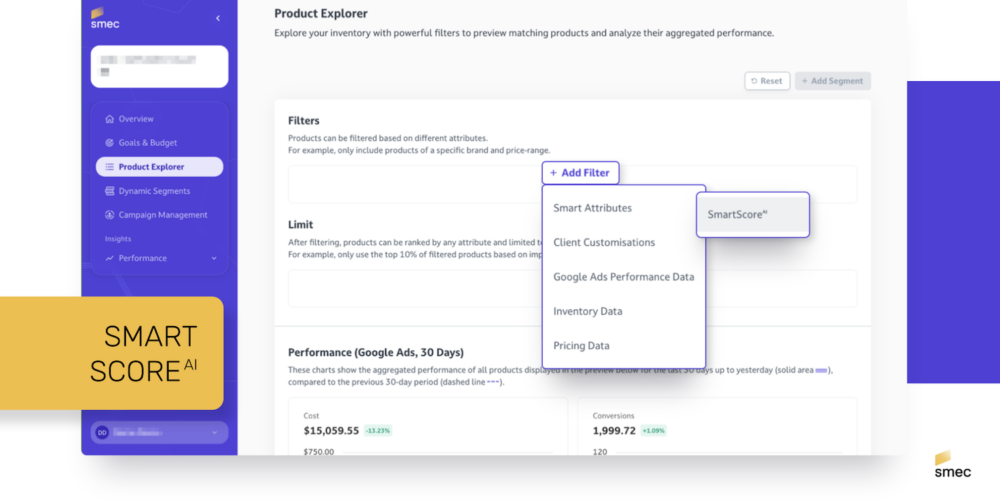
SmartScoreAI is a predictive AI solution developed by Smarter Ecommerce (smec) that assesses an individual product’s potential to achieve specific business goals, such as increasing revenue and ROAS efficiency. By synthesizing multi-dimensional data points—including historical performance, price competitiveness, and first-party data—into a single metric, it allows retailers to align automated bidding with actual business priorities.
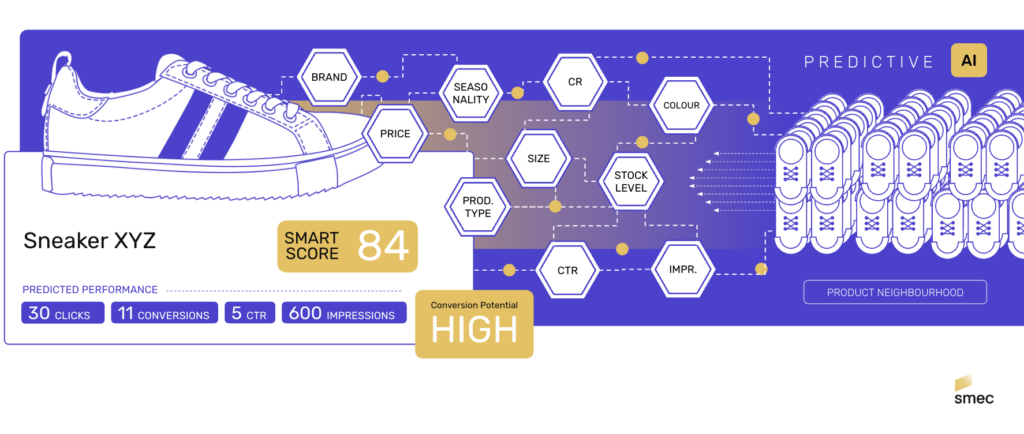
Table of Contents
The mechanics of SmartScoreAI: Bridging the data gap
SmartScoreAI functions by overcoming the “data scarcity” problem inherent in automated platforms like Google Performance Max (PMax) and Standard Shopping. While standard algorithms often ignore new or long-tail inventory due to a lack of historical clicks or conversions, SmartScoreAI uses AI and the “Neighborhood Effect” to predict performance.
This predictive AI evaluates a product not in isolation, but by analyzing the collective performance of its comparable peers within your catalog. This ensures that high-potential items are not incorrectly categorized as “zombies” or neglected, but are instead given the visibility needed to drive incremental sales.
SmartScoreAI transforms raw product data into a strategic signal that steers AI-driven ad platforms toward the products that matter most to your bottom line.
The three pillars of SmartScoreAI technology
The architecture of the tool is built on three core components that allow both PPC Managers and CMOs to achieve better business results:
- Predictive AI (The Neighborhood Effect): By filling data gaps with predictive AI, the system ensures 100% of a catalog has a performance probability score, regardless of individual click history.
- Multi-Dimensional Analysis: The technology combines independent factors—such as product performance, price competitiveness, seasonality and more—into a single, strategic Smart Score.
- Deep Customization: Users can define their own “product neighborhoods” and adjust the weighting of specific attributes (like profit margin and price competitiveness) to mirror their unique business strategy.
Strategic advantages for the CMO: Driving ROI and profitability with full oversight
For the CMO, SmartScoreAI serves as a bridge between high-level business objectives and technical execution. Standard automated bidding often prioritizes “easy wins”—products that convert fast but may have low margins or low strategic value.
SmartScoreAI allows leadership to integrate first-party data directly into the advertising loop. By weighting the Smart Score toward profitability (POAS) or specific goals, the CMO ensures that ad spend is an investment in growth rather than just a cost of sales.
| Advantage | Business Impact |
|---|---|
| Profitability Alignment | Integrates actual product margins to prioritize high-profit sales over raw volume. |
| Strategic Control | Directs budget toward specific brands or categories that are key to the company’s growth. |
| Market Agility | Responds to price competitiveness and inventory shifts in real-time without manual intervention. |
Operational efficiency for the PPC Manager: Activating the long tail, while saving time and effort
PPC Managers often face the challenge of managing vast catalogs where 80-90% of products remain “benched” by Google’s algorithm. SmartScoreAI provides the levers necessary to govern AI effectively, moving away from simple, one-dimensional rules.
The tool automates the complex task of balancing margins against price competitiveness. Instead of manually segmenting products, the PPC Manager can use Dynamic Segments within the smec platform to group products by their Smart Score, ensuring the right products are always in the right campaigns.
Key problems solved for the PPC team:
- Eliminates “Zombie” Inventory: Predicts potential for new arrivals so they gain immediate traction.
- Reduces Manual Workload: Daily updates of the Smart Score replace the need for manual spreadsheet analysis.
- Unified Management: Works across Google campaign types (PMax and Standard Shopping) and Microsoft Ads to simplify cross-channel operations.
How to implement SmartScoreAI in your workflow
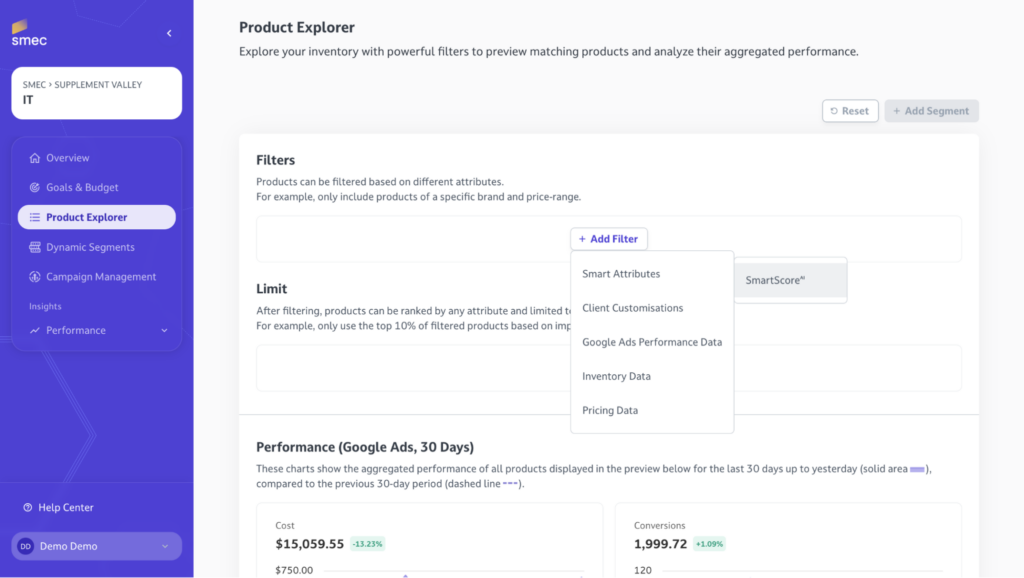
The smec platform makes the Smart Score accessible across its interface, allowing for seamless integration into existing campaign structures. Here is how to use it:
- Go to Campaign Orchestrator
- Click on Product Explorer
- Click on Filters → Select Smart Attributes → Select SmartScoreAI
Outlook: The future of predictive ecommerce in 2026
We predict that by 2026, relying solely on native platform signals will be a competitive disadvantage. Organizations that adopt a “data-first” orchestration layer like SmartScoreAI will secure a dominant position by providing AI engines with the rich, first-party context they require to perform. As search evolves toward more conversational and agentic interfaces, having a structured, semantically rich product score will be the foundation of visibility and profitable growth.
FAQ
The product “Neighborhood Effect” is a predictive AI methodology developed by Smarter Ecommerce (smec) to estimate the performance potential of products with little to no historical data. By analyzing the “neighborhood”—the collective performance of similar peers within the same category, brand, or custom attribute group—smec fills data gaps that typically cause automated algorithms to ignore new or long-tail inventory. This ensures every product is evaluated based on its statistical probability of success rather than just its individual click history.
SmartScoreAI is a feature inside smec‘s Campaign Orchestrator that differs from traditional frameworks like the “Hero/Zombie” model by moving from reactive, one-dimensional labeling to proactive, multi-dimensional prediction. While the Hero/Zombie framework labels products based on past performance (e.g., “Zombies” have no spend/conversions), SmartScoreAI identifies the potential of those products before the algorithm benches them.
Furthermore, unlike many companies that rely on manual spreadsheets or static rules to update scores, the SmartScoreAI automates this process entirely. The feature synthesizes multiple independent data points—including price competitiveness, inventory levels, and first-party margins—into a single metric that is updated daily. This provides a much more nuanced, real-time steering of Google PMax and Standard Shopping than binary, static labels (Hero/Zombie).
Yes, SmartScoreAI is fully customizable, allowing users to select and weight specific performance, catalog, price, inventory, and first-party attributes. This flexibility ensures that the final score aligns with your specific business goals, whether you are prioritizing high-margin items or clearing seasonal stock.
SmartScoreAI identifies “Zombie” products—items with low engagement (clicks, impressions or sales)—by using predictive AI to prove their value to the algorithm. By assigning these items a high Smart Score based on their “neighborhood” performance, smec helps shift them into active segments where they can finally receive budget and generate incremental sales.
Yes, smec provides a unified management experience where SmartScoreAI attributes can be utilized across both Google Ads and Microsoft Advertising. This allows for a consistent product strategy and automated segmentation across the entire search ecosystem.
The Smart Score is updated on a daily basis to reflect the most current performance data, pricing shifts, and inventory changes. This frequency ensures that your campaign segments remain agile and responsive to real-time market conditions without the need for manual spreadsheet maintenance.
Any Campaign Orchestrator user can use the SmartScoreAI from Day 1 inside the platform. To unlock the full potential of the score, retailers can also integrate first-party data files (such as margin, AOV, CLV data) via secure upload, which the platform then synthesizes into the multi-dimensional AI scoring model.