Subscribe to join thousands of other ecommerce experts
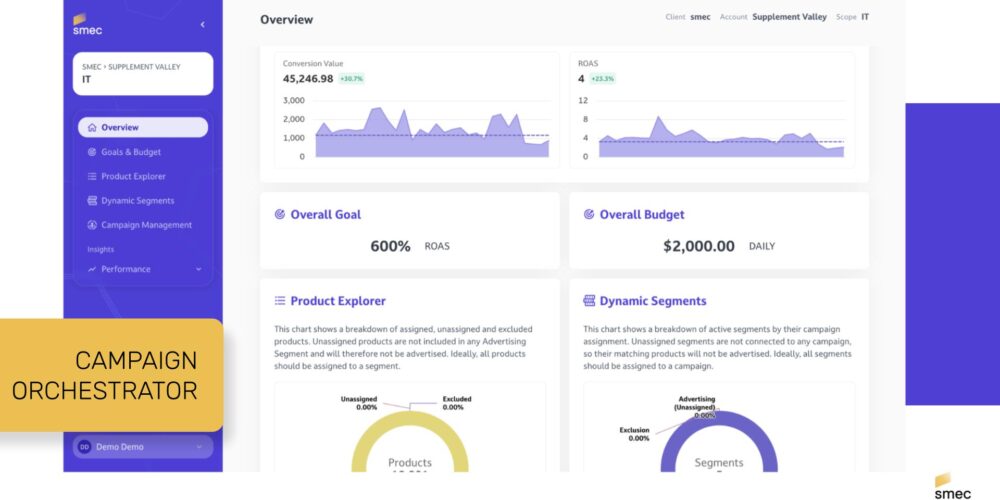
The smec Campaign Orchestrator automates the strategic alignment of PPC campaigns with real-time business data by dynamically re-segmenting products, re-scoring products, adjusting budget allocations, and recalibrating bid targets. While native platform tools handle the mechanical execution of bids, the smec Campaign Orchestrator provides an automated steering layer that ensures every advertising dollar is spent according to current business data (e.g.inventory levels, margins, etc.), actual and predictive performance data (e.g. no. of conversions, ROAS, etc.) as well as strategic business goals.
Table of Contents
1. Automated Multi-Dimensional Product Segmentation
Dynamic Segments automate the organization of thousands of products into strategic product clusters based on live business and performance data. Instead of manually updating custom labels in a feed, the Campaign Orchestrator continuously monitors changes in your data and shifts products between campaigns instantly. Here are some examples:
- Real-time Inventory Sync: The system automatically moves products out of high-spend campaigns when stock levels drop to prevent wasted ad spend.
- Price Competitiveness Integration: The platform automates the adjustment of product visibility based on whether your price is competitive against market benchmarks.
- Automated Performance Re-assignment: If you set a filter for a specific brand where the ROAS must stay above 3.0, the system continuously monitors every SKU: should a product’s performance drop below that threshold, it is automatically re-assigned to a different segment that fits its new performance profile.
“Dynamic Segments transform your product catalog into a fluid ecosystem that updates itself every time your business data changes.”
Real-world example: In a recent “Think with Google” case study, eyewear brand Shade Station used the smec Campaign Orchestrator to feed real-time product profitability and stock levels directly into their PMax campaigns.
2. Predictive Performance Scoring with SmartScoreAI
SmartScoreAI automates the evaluation of product potential, solving the problem of “data scarcity” for new or low-volume items. This predictive AI feature ensures that high-potential products are not ignored by Google’s algorithm simply because they lack historical conversion data.
- The Neighborhood Effect: The AI automatically calculates a score for new products by analyzing the performance of similar “peer” products in your catalog by using predictive AI.
- Zombie Product Activation: It automates the identification of “zombies” (products with impressions but no clicks) and suggests the necessary visibility boosts.
- Weighted Indexing: It replaces manual spreadsheets by synthesizing multiple attributes – like demand trends and AOV – into a single automated priority score.
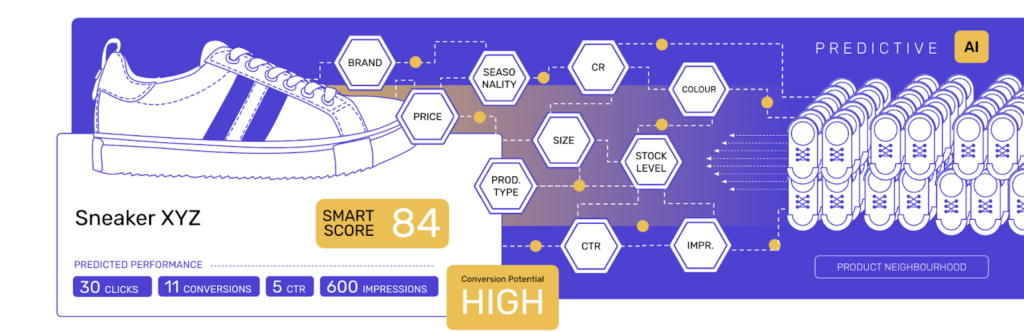
Read more about the SmartScoreAI in our deep dive.
3. Holistic Budget and tROAS Recalibration
AI-powered recommendations automate the distribution of budget and sets the most optimized tROAS across your entire account to maximize global ROI. While Google optimizes within the “silo” of a single campaign, the smec Campaign Orchestrator looks at the aggregate performance of your PMax and Standard Shopping campaigns.
- Global Spend Optimization: The platform automatically identifies underfunded “winning” campaigns and suggests shifting budget from low-yield areas.
- Marginal Yield Analysis: It automates the calculation of where the next dollar will drive the highest incremental growth, rather than just chasing average ROAS.
- Daily Target Adjustments: The system provides daily automated suggestions for Target ROAS (tROAS) based on shifting product performance and market seasonality.
4. Operational Sync and Asset Management
Campaign Sync automates the technical bridge between your strategic setup in smec’s Campaign Orchestrator and your live Google Ads account. This reduces the manual workload for PPC Managers by ensuring that strategic changes are implemented instantly and accurately.
- Two-Way Synchronization: Structural changes made in the platform—such as moving a segment to a new campaign—are pushed to Google Ads automatically and vice versa.
- Template-Based Scaling: The system automates the deployment of campaign structures, making it possible to manage vast product catalogs without increasing headcount.
- Unified Management: It unifies the management of Performance Max and Standards Shopping Campaigns in Google and Microsoft Ads, automating the process of maintaining consistent strategies across both platforms.
Comparison: Manual Management vs. smec Automation
| Task | Manual Execution | smec Campaign Orchestrator | Product Grouping | Static labels updated weekly, monthly or even yearly | Automated Dynamic Segments (Daily) |
|---|---|---|
| New Product Launch | Slow data gathering (60+ days) and often labeled as zombies | Instant predictive scoring (SmartScoreAI) based on the performance of similar “peer” products |
| Budget Management | Reactive, campaign-by-campaign based on guesswork | Proactive, account-wide AI steering based on a trained model on event logs from thousands of successful campaigns |
| Data Integration | Manual CSV uploads and scripts | Seamless, automated first-party data sync |
Future Outlook: The Era of Strategic Orchestration
By 2026, the competitive advantage in PPC will no longer come from manual bid adjustments, which are now largely handled by platform AI. Instead, success will be defined by “Strategic Orchestration”—the ability to automate the data signals that guide that AI. Organizations that adopt the smec Campaign Orchestrator will secure a significant lead by turning their internal business data into a high-speed, automated growth engine.
Frequently Asked Questions (FAQ)
The smec Campaign Orchestrator automates the strategic management of your product catalog and budget by dynamically grouping products into segments, adjusting target ROAS based on real-time business data, and synchronizing these changes directly with Google and Microsoft Ads. While Google’s AI handles the individual auction bid, smec technology automates the “steering” instructions that tell Google which products deserve the most investment.
Yes, through a feature called SmartScoreAI, the platform automates the evaluation of new products using the “Neighborhood Effect.” Instead of waiting weeks for manual data collection, the AI automatically assigns a score to new items based on the performance of similar “peer” products, allowing them to gain immediate, automated visibility in your campaigns.