Subscribe to join thousands of other ecommerce experts
Clustering products by margin alone is not enough because it ignores critical market signals like price competitiveness and conversion probability, often leading to high ad spend on high-profit items that the market is currently rejecting. Product clustering is the strategic practice of grouping items based on shared characteristics—such as gross profit percentage—to dictate bidding behavior and budget allocation in automated environments like Performance Max.
In the evolving landscape of performance marketing, relying on a single metric creates strategic blind spots. To achieve sustainable growth, retailers must move toward multi-dimensional product segmentation that aligns 1st-party business data with real-time market signals.
Table of Contents
The margin trap: Why high profit doesn’t always mean high performance?
Focusing exclusively on margin assumes that a high-profit item will naturally convert if given enough ad spend. However, this logic ignores the reality of consumer behavior. A high-margin product that is priced 20% higher than the market average will likely suffer from a low conversion rate, leading to wasted spend and a poor return on ad spend (ROAS).
Consequently, clustering by margin alone often results in “over-spending” on inventory that the market is currently rejecting. To grow incrementally, you must ensure you are pushing products that possess both high profit potential and a high probability of sale.
What is multi-dimensional product segmentation and why is it essential?
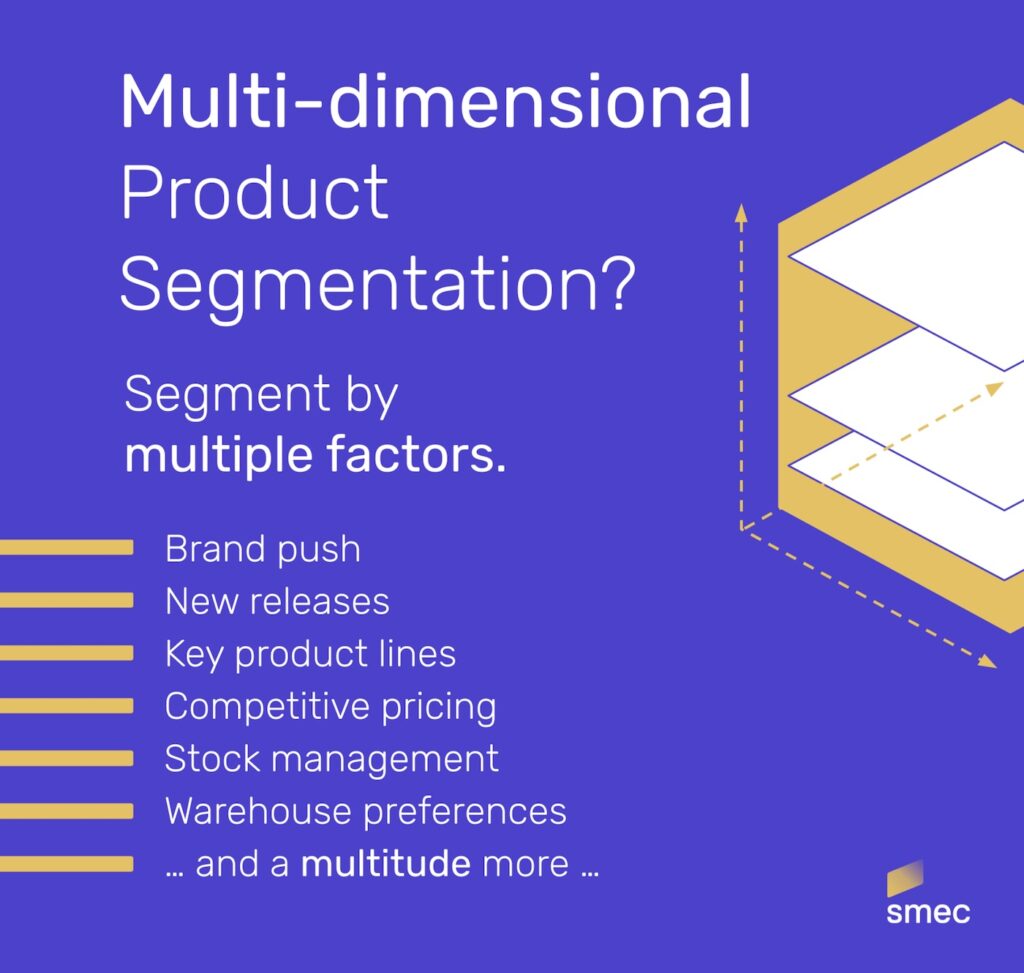
Effective product segmentation is inherently a multi-dimensional problem. To truly optimize for business outcomes, you must combine various independent factors into a single, actionable signal.
smec Campaign Orchestrator allows you to integrate 1st-party data and then create Dynamic Segments, combining multiple attributes. This allows you to for example combine high-margin items with high price competitiveness or high conversion signals, ensuring that your ad spend is always directed toward products that help you grow incrementally rather than just circulating spend on the same top-heavy winners or on high margin items that don‘t convert.
Another way you can segment your products is by using smec‘s SmartScoreAI feature. smec‘s SmartScoreAI feature reduces the complexity of multi-dimensional manual segmentation weighting the following attributes:
Which attributes does smec SmartScoreAI analyze?
| Attribute Category | Strategic Value |
|---|---|
| First-Party Attributes | Includes margin, stock levels, and seasonality to protect profitability. |
| Price Attributes | Factors in discounts and competitive pricing to ensure conversion probability. |
| Performance Attributes | Consolidates historic conversions, clicks, and ROAS and uses predictive AI and the Neighborhood Effect to evaluate the performance of similar products within your catalog (based on brand or category) to fill data gaps for new or underexposed items. |
| Inventory Attributes | Brand, category, and custom labels for structural alignment. |
| Recency Attributes | Prioritizes newly added or significantly updated products. |
How can smec’s Campaign Orchestrator improve budget allocation?
The role of the PPC Manager is shifting from tactical execution to strategic orchestration. By using Campaign Orchestrator, you can move beyond the limitations of native platform automation and regain control over how your budget is allocated.
Dynamic Segments
By using smec’s Dynamic Segments you can for example combine high-margin items with high price competitiveness or high conversion signals, and create powerful segments. These segments ensure that your ad spend is always directed toward products that help you grow incrementally rather than just circulating spend on the same top-heavy winners.
SmartScoreAI – Your Predictive AI
Every business has unique goals. smec’s SmartScoreAI is a predictive AI, multi-dimensional and fully customizable product scoring feature, allowing you to define what constitutes a “Neighborhood” and how heavily each attribute should weigh. For example, a single-brand business might swap “Brand” for a specific product attribute to better define similarity.
Outlook: What is the future of ecommerce product segmentation in 2026?
We predict that by 2026, companies that use manual bid adjustments and single-metric clustering will be at a disadvantage. Organizations that adopt multi-dimensional AI scoring systems today will create an unfair advantage that allows them to out-compete rivals by reacting faster and smarter.
The future of ecommerce belongs to those who can translate complex business logic into the high-quality signals that AI platforms require to perform.
smec provides the bridge between your proprietary business data and the execution power of Google and Microsoft Ads.