Subscribe to join thousands of other ecommerce experts
While the industry focuses on Profit On Ad Spend (POAS) as the ultimate solution for eCommerce profitability, our analysis suggests that relying solely on this metric restricts absolute profit growth. This article introduces the True Profit Optimization framework to solve the structural limitations of target-based bidding. By shifting from static efficiency targets to dynamic product segmentation, brands can maximize actual profit volume instead of merely protecting ad spend efficiency.
When POAS (Profit on Ad Spend) was first introduced, it felt like a solution to a longstanding problem marketers have had for years. Advertisers were finally optimizing for profits rather than just gross revenue. Or so it seemed.
However, belief has a critical flaw: POAS is an efficiency ratio, not a volume driver. It wears a profit coating but behaves restrictively, costing large retailers millions in untapped absolute profit.
In this blog post, we will break down the profit-misconception behind POAS and showcase what you should do to optimize your Google Ads for profitability instead.

Table of Contents
What is POAS and how does POAS compare to ROAS?
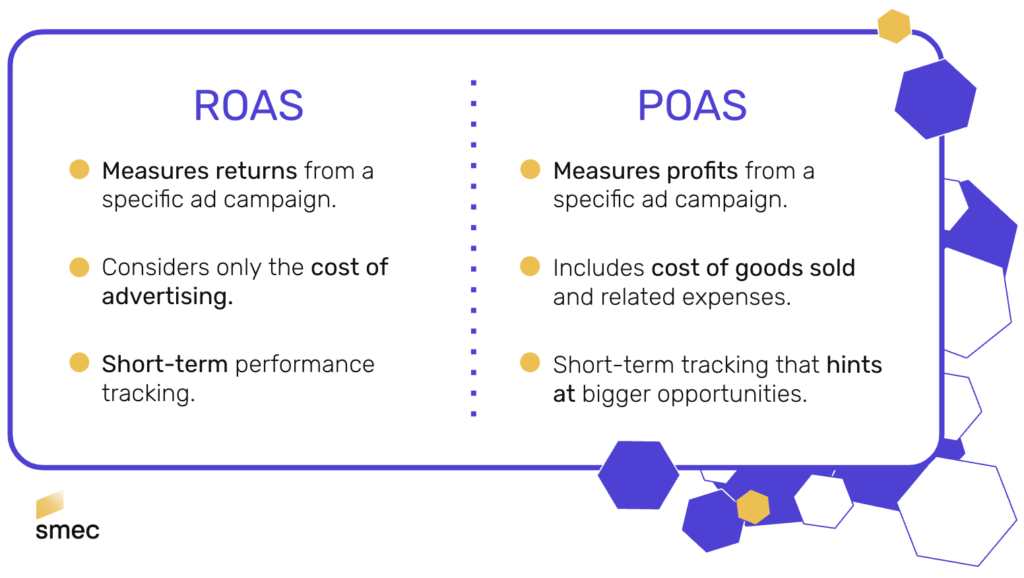
POAS (Profit On Ad Spend) is an efficiency metric that measures the gross profit generated for every dollar spent on advertising an item, whereas ROAS (Return On Ad Spend) only measures the top-line revenue generated per ad dollar.
The shift toward POAS occurred because retailers needed a metric that accounted for the Cost of Goods Sold (COGS). For years, ecommerce relied on ROAS. However, if a retailer sells a $100 product for a $10 ad spend, the ROAS looks incredible, even if the product costs $95 to manufacture and ship resulting in a net loss.
POAS was introduced to fix this blind spot by giving PPC Managers visibility into actual gross profit. However, the calculations reveal a fundamental structural flaw. Both metrics rely on identical logic:
- ROAS Formula: Total Revenue divided by Total Ad Spend.
- POAS Formula: Gross Profit divided by Total Ad Spend.
Furthermore, both metrics share another critical limitation: they are strictly per-item metrics. POAS calculates the profit of an individual transaction, completely ignoring your entire inventory depth, tied-up capital, or overarching business goals. It does not know if you have a warehouse full of dead stock that needs to be liquidated or if a product drives high long-term value. Like ROAS, it only looks at the immediate efficiency of a single sale.
While the numerator changes from revenue to profit, the mathematical output remains identical. They are both ratios. Within Google Ads Smart Bidding, both metrics act as a rigid ceiling.
If an advertiser sets a Target POAS of 250%, the algorithm will deliberately restrict visibility to ensure that exact ratio is met. It fundamentally cannot maximize total cash profit because it is programmed to prioritize the efficiency ratio above all else.
What is the difference between POAS and True Profit Optimization?
POAS is a restrictive efficiency metric used to manage ad spend, whereas True Profit Optimization is a holistic, data-driven strategy designed to maximize the absolute cash volume a business generates.
Many retailers operate under the dangerous misconception that a high POAS target guarantees a highly profitable business. In reality, optimizing for a ratio and optimizing for absolute profit require entirely different approaches. When we talk about True Profit Optimization, we are talking about three core pillars:
- Maximizing Absolute Currency over Percentages: Instead of aiming to hit a specific efficiency percentage (e.g., a 250% return), True Profit Optimization focuses on generating the maximum amount of actual cash profit (e.g., $50,000 in the bank). You accept a lower efficiency ratio if it yields a massive increase in total cash.
- Multi-Dimensional Bidding: Simply segmenting products because they have a “high margin” is a flawed strategy. A high-margin product with zero market demand or poor pricing will just burn ad spend. True Profit Optimization dynamically scales volume by combining absolute margin data with predictive conversion potential.
- Predictive Goal Alignment: True Profit Optimization does not treat every product equally. It uses predictive AI to calculate the true business value of every item and automatically shifts budgets toward segments with the highest predictive growth.
You can achieve a 500% POAS on $10 of ad spend, yielding $50 in profit, while sacrificing the opportunity to make $5,000 in absolute profit at a 200% POAS. Profit Optimization ensures you never leave that $5,000 on the table.
Why is POAS a bad indicator for profitability?
POAS fails to drive absolute profit because it forces automated bidding algorithms to protect ad budgets rather than maximizing market share for products with true absolute profit potential.
Crucially, true profit needs to be measured across your entire account. POAS is a per-item metric that does not factor in the complexity of your entire business.
You could drive a massive 500% POAS selling one specific item, but if that item has negligible search volume while your warehouse is full of stagnant inventory, your overall business profitability will stagnate.
Subjective opinions require objective validation. The limitation of POAS is rooted in the mathematical constraints of automated bidding systems. Google Ads Smart Bidding algorithms are designed to hit the specific target constraint provided by the advertiser.
We observe that strictly enforcing a high Target POAS systematically harms performance in three specific ways:
- Suppresses Impression Share: The algorithm overemphasizes pushing products with strong historical performance while putting products that might have a stronger chance to convert, but lack a comparable historic performance at a disadvantage.
- Limits Absolute Profit: It penalizes products that could generate massive cash volume at a slightly lower POAS percentage.
- Sacrifices Market Dominance: Retailers win the efficiency battle but lose market share to competitors willing to buy volume.
How can you optimize your ads for profits?
Retailers can optimize for true profitability by using specialized PPC software like the smec Campaign Orchestrator to integrate first-party business data directly into their campaign structure.
To break free from the efficiency illusion of POAS, organizations must orchestrate their ad spend based on absolute margin potential. The smec platform achieves this through a structured, four-step operational protocol:
1. Integrate Business Data
The first step is feeding the algorithm the exact metrics that dictate true profitability. Retailers must input critical data points, including:
- Cost of Goods Sold (COGS)
- Return rates and shipping costs
- Target profit margins
- Customer Lifetime Value (CLV)
2. Activate SmartScoreAI
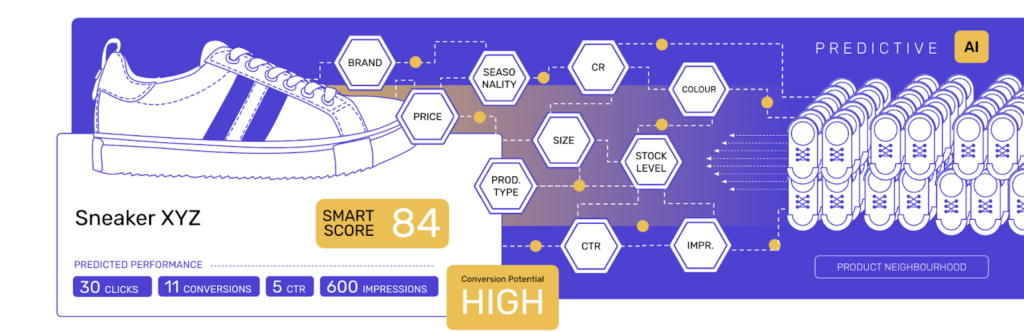
Segmenting your catalog strictly by “high margin” is a trap. If a high-margin item has poor pricing or zero historical data, pushing budget toward it will ruin your efficiency. Once data is integrated, the platform activates SmartScoreAI to solve this. It scans the entire product library and utilizes the Neighborhood Effect to compare each individual product with the shared attributes of every other product in the catalog. It evaluates item-level metrics such as:
- Price competitiveness against the market
- Historical conversion rates
- Current stock depth
- Brand demand and seasonality
Based on this analysis, the AI creates a Smart Score for each item that reflects its true predictive potential to convert clicks into profitable sales, rather than relying on margin alone.
3. Build Dynamic Segments
Based on this score, the system automatically assigns every product in the library to a Dynamic Segment based on inputted business goals. For example, instead of a generic seasonal clearance segment, a retailer can create a “High Absolute Profit” segment. This automatically groups items that possess both high gross margins and strong predictive conversion potential.
4. Orchestrate Goal-Driven Campaigns
Finally, these product segments are automatically routed into campaigns that focus on increasing the bottom line. A profit-optimized account structure includes campaigns such as:
- Profit Maximizers: Scaling volume for products with high margins and high Smart Scores.
- Inventory Liquidators: Pushing overstocked items to free up tied capital while maintaining baseline efficiency.
- New Customer Acquisition (NCA): Promoting products proven to attract first-time buyers with high long-term value.
- Zombie Revival: Allocating controlled budget to dormant products that the AI predicts will perform well based on peer attributes.
The smec Campaign Orchestrator scans the product library on a daily basis. It adjusts automatically to changes in market conditions. If a product runs low on stock, it is automatically pulled from the Profit Maximizers segment to prevent wasted spend. If a competitor drastically lowers their price, the system recalibrates the Smart Score and shifts the item to a protective segment to preserve margins.

What is the future of ecommerce profit optimization?
The future of eCommerce advertising belongs to organizations that abandon static POAS targets and adopt True Profit Orchestration to secure dominant market share.
We predict that by 2026, static POAS bidding will be obsolete for enterprise retailers. As the industry moves toward Agentic Commerce, the most effective organizations will focus on three strategic imperatives:
- Abandoning Static Ratios: Moving away from POAS targets that restrict volume.
- Integrating Specialized Tech: Utilizing tools like the smec Campaign Orchestrator to feed business logic directly into ad platforms.
- Combining Human Strategy with AI Execution: Using human expertise to architect the data and AI to orchestrate the bids.
AI executes, but people strategize. Organizations that master this balance will capture maximum profit volume, while competitors remain constrained by the struggle to maintain arbitrary efficiency ratios.