Subscribe to join thousands of other ecommerce experts

Google’s Universal Commerce Protocol (UCP) creates a standardized language for AI agents to execute frictionless transactions, forcing retailers to choose between losing brand control to Google or risking total invisibility. To stay profitable, advertisers must shift from keyword-based strategies to high-density data hygiene and multi-dimensional product segmentation to ensure AI agents prioritize business margins over simple revenue.
The headlines coming out of NRF 2026 regarding Google’s Universal Commerce Protocol (UCP) sound like standard tech utopianism. Frictionless shopping! AI agents buying for you! The future is here!
But if you strip away the buzzwords, what Google is actually proposing is a fundamental restructuring of the ecommerce value chain.
And if you are a PPC manager or Head of Marketing, you need to pay attention.
Table of Contents
What even is Google’s Universal Commerce Protocol?
First, we need to clear up a massive misconception floating around LinkedIn: UCP is not just a Merchant Center update.
Think of the “War of Currents” in the late 19th century. It was Edison vs. Tesla to set the standard for how the world received power. That is what UCP is—it’s an infrastructure battle.
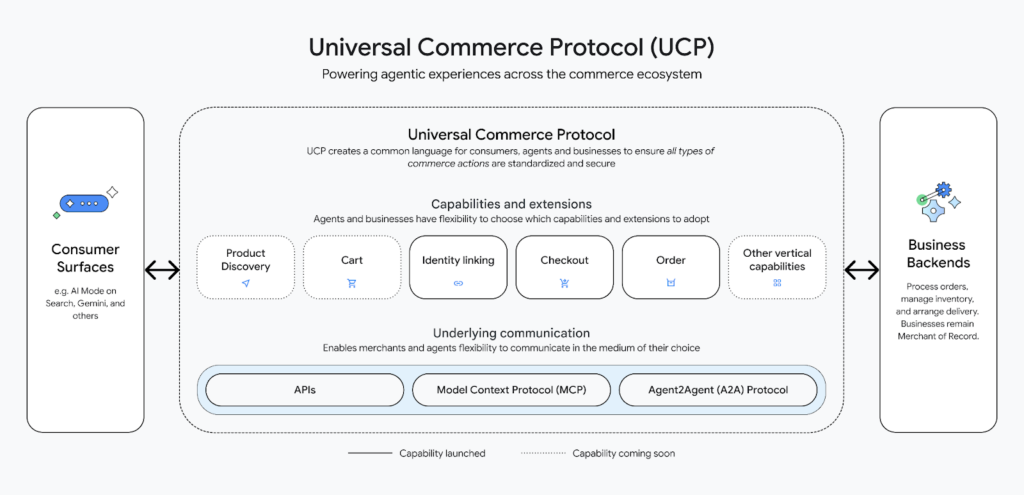
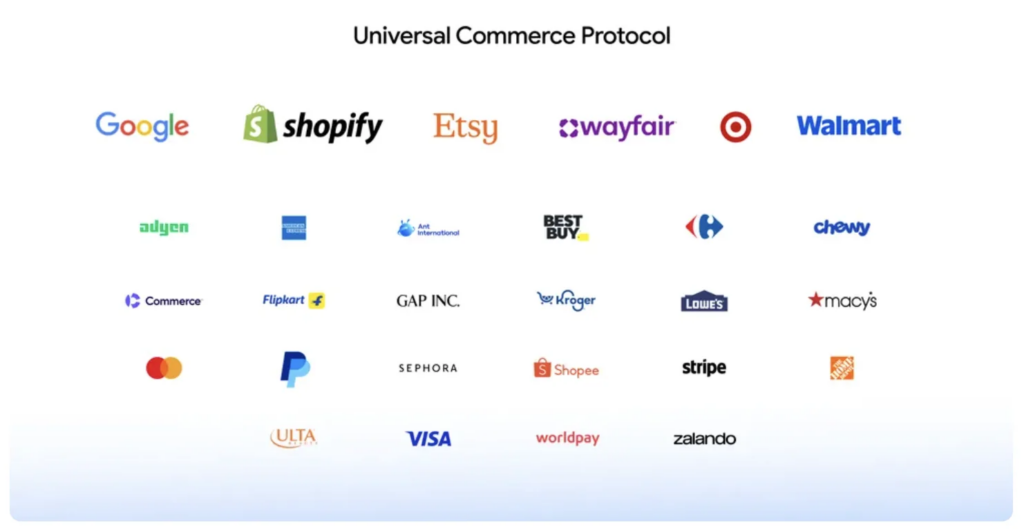
Google, in partnership with Shopify, Walmart, and 22 other major ecommerce players, is trying to set the standard language that AI agents use to talk to each other. At its core, UCP breaks down the entire shopping experience into standardized “Capabilities”—think of them as digital Lego bricks:
- Discovery: The ability to find items.
- Cart: The ability to hold items.
- Checkout: The ability to transact.
When a user’s AI agent interacts with a brand’s AI agent, they perform a technical “handshake” to see which capabilities they share. If they both speak “UCP,” they can instantly execute a complex transaction—finding the boots, applying a discount code, and processing payment—without ever needing a custom API integration or a human click.
- The strategy: Google is planting a flag to fight Amazon. By creating an “open” standard, they are building an ecosystem where Google is the interface, and you are the infrastructure.
Right now, Google is introducing these agentic shopping capabilities exclusively in the US market. As far as Europe is concerned? We don’t know when it’s going to happen.
Google is no stranger to tangoing with the EU’s bureaucracy, and there are plenty of legal hurdles on the horizon before a full rollout can realistically happen.
The “Prisoner’s Dilemma” of frictionless commerce
Google frames UCP as a win for everyone because it removes friction. And yes, frictionless commerce usually leads to higher transaction volumes. But there is a catch.
This creates a classic Prisoner’s Dilemma for retailers:
- Scenario A: You participate. You integrate with UCP (via Shopify or custom API). Your products become eligible for Agentic AI purchases. Sales volume likely increases, but you lose the site visit. You lose the cross-sell opportunity. You lose the ability to capture that email address for your own CRM. You effectively become a backend logistics provider for Google’s storefront.
- Scenario B: You opt out. You keep your brand integrity and data ownership. But as consumer behavior shifts toward AI-driven “do it for me” shopping, you risk becoming invisible.
In the past, retailers had the leverage to say no. They forced Google to send the traffic to their websites. But in 2026, when the AI is the marketplace, opting out doesn’t mean saving your traffic—it means removing your products from the shelf entirely.
You likely no longer have the leverage to say no. So, if you have to play the game, you better know the new rules: Data Hygiene will become your biggest strategic lever.
The new SEO is feed engineering
While the pundits are obsessing over “Agentic AI,” the actual path to winning in 2026 is surprisingly unsexy. It isn’t about prompt engineering. It’s about Data Hygiene.
If UCP is the language the agents speak, your Product Feed is the vocabulary. If your vocabulary is limited, the AI simply cannot understand what you are selling.
In the keyword era, you could get away with a messy feed if your bids were high enough. You could stuff “Waterproof Running Shoes” into a title and capture the traffic.
In the Agentic era, Keywords are dead. Attributes are King.
When an AI agent is tasked with buying “sustainable, waterproof hiking boots for a trip to Iceland,” it is not looking for keywords. It is verifying structured data fields against the UCP standard. It is a strict, rules-based negotiation.
- Does the [material_origin] attribute specify “recycled”?
- Is the [care_instruction] field populated? (A new “conversational attribute” currently in beta).
- Is the [native_checkout] attribute set to true?
If you leave these fields blank (or “implicit”), the AI cannot verify the product satisfies the user’s constraint. You don’t just get a lower Ad Rank—you get disqualified from the negotiation entirely.
The Fix: You need to audit your Merchant Center today. Stop treating your feed like a static inventory list. It is now your primary landing page.
Frictionless spending requires complete control
A warning on profitability.
The “Universal” in Universal Commerce Protocol implies that transactions will become frictionless. But frictionless spending is dangerous if you don’t control what is being sold.
Automation seeks the path of least resistance. If you feed the UCP-enabled ecosystem generic revenue targets (ROAS), it will burn your budget on your “Zombies”.
The “Lazy AI” Problem: AI agents are profit-blind. They don’t know that your best-selling sneaker has a 2% margin. They don’t know that a certain dress has a 40% return rate. They only know that these items have a high conversion probability.
If you let UCP-enabled agents buy whatever they want to hit a ROAS target, they might end up filling your order book with low-margin, high-return inventory. You will be busy, but you won’t be profitable.
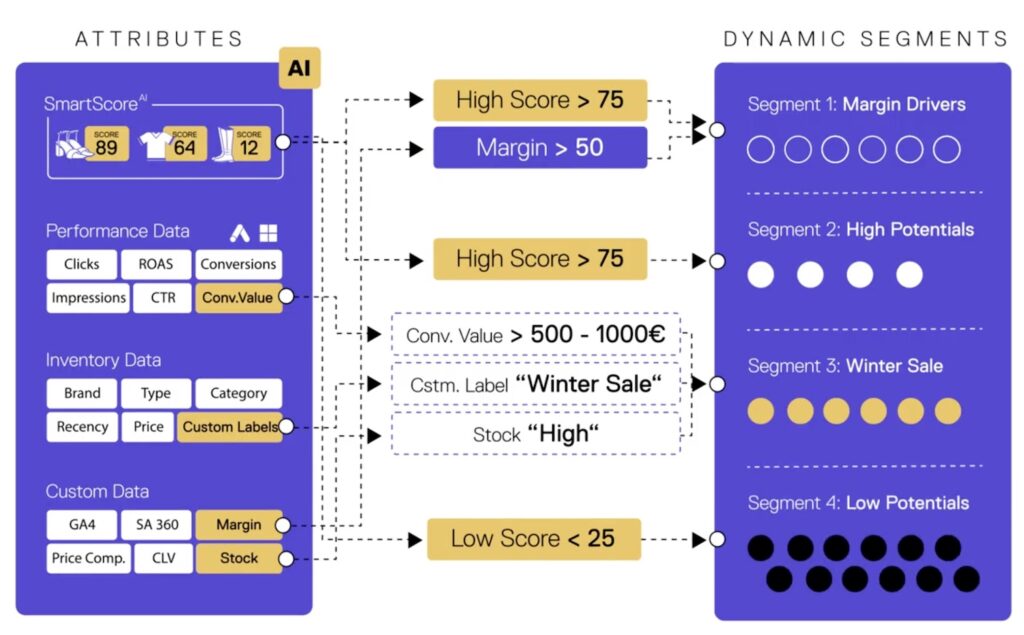
To be ready for the UCP era, you must ensure the AI will pick up on the products that actually matter to your business (and bottom line). The best way to do this? Multi-dimensional, Dynamic Product Segmentation:
- Categorize your products by Profit Margin and Return Rate, not just revenue.
- Steer the AI by feeding it different targets for “Margin Drivers” vs. “Bleeders.”
- Validate your feed data constantly. Garbage data in means garbage spending out.
- Structure your product catalog by utilizing Dynamic Segments and assign Smart Scores to split your catalog into profitability buckets (e.g., ‘margin drivers’ for high margin, ‘low potentials’ for low margin).
Future-proof your product feeds for Gemini Ads
Admittedly, we are getting into speculation territory here.
Unlike AI Mode and AI Overviews, Google DeepMind CEO Demis Hassabis recently went on record stating there are no current plans to run Google Ads placements within Google’s chatbot interface directly.
However: Competitor pressure moves mountains. With OpenAI officially introducing ads into the free and budget tiers of ChatGPT, the likelihood of the world’s biggest paid ads conglomerate following suit seems sound.
The trend: With the dizzying developments in AI shopping experiences, don’t be surprised if Google Ads officially make their way into Gemini sooner rather than later. Don’t wait for the press release. Prepare to win the auction before it even opens.
- Fill the “ghost” attributes: In the keyword era, you could skip fields like [pattern] or [occasion]. In the Gemini era, these are fatal errors. If the entity isn’t defined, the AI can’t see it.
- Explicit > implicit: Don’t leave it to the AI to guess. Hard-code your data points – [insulation: down], [style: formal]. The more granular your data, the more “hooks” the AI has to pull you into the answer.
The bottom line: Even if Gemini Ads don’t launch tomorrow, this level of data hygiene will immediately supercharge your current PMax and Shopping campaigns. You are essentially future-proofing your business while optimizing your present.
The bottom line
While Google is seemingly prepping for a future where chatbots handle your grocery shopping, let’s not get too ahead of ourselves.
This isn’t a sudden revolution. Google has been building this exact Ads environment ever since the rollout of Performance Max in 2022. These aren’t dramatic new shifts; they are the maturation of a strategy we have all been living with for years.
The methods to win—data density, segmentation, and profit focus—are tried and tested.
Whether your ad appears on a traditional SERP or inside a future AI conversation, the requirement is the same: You need to feed the machine the right signals.
If you need help mastering your Google Ads today to make them ready for whatever tomorrow brings: