Subscribe to join thousands of other ecommerce experts

The March 2026 update introduces enhanced Performance Max (PMax) and Standard Shopping controls within the smec Campaign Orchestrator, alongside a major upgrade to SmartScoreAI. Key features include Smart Attributes for segment weighting and the new Feed Composition Insights dashboard for feed health auditing.
Core Feature Enhancements
- Connecting existing PMax and Standard Shopping Campaigns: You can now create and link existing PMax and Standard Shopping campaigns directly within the smec Campaign Orchestrator, streamlining cross-campaign management.
- Smart Attributes: This new feature gives you granular control over product segments by allowing you to manually weight AI influence on performance, pricing, recency and first-party data.
- Improved SmartScoreAI: The model has been upgraded to a more powerful, multidimensional and customizable version, allowing for more sophisticated scoring based on your specific business goals.
New Feed Management Tools
The launch of Feed Composition Insights provides a new dashboard built to optimize your product data for both traditional search and Generative Engine Optimization (GEO). This tool allows you to:
- Audit Title Lengths for AI Overviews: Ensure your product titles are optimized to appear in Google’s AI Overviews. While Google allows 150 characters, placing your most important details in the first 50–70 characters is vital. This ensures your key selling points aren’t cut off in AI-generated summaries.
- Prevent Information Loss: If your main attributes (like brand or material) are at the end of a long title, the AI may hide them behind “…” or ignore them when deciding if your product is a match for a user’s question.
- Monitor Missing GTINs: Quickly identify and fix missing Global Trade Item Numbers so Google’s AI can clearly identify your products as distinct, “recommendable” entities.
- Visualize Distributions: Track your price and category distribution over time to ensure your feed stays fresh, a key factor for AI agents when they choose which products to feature.
Let’s dive into the major changes and new tools included in this release.
Table of Contents
Connect existing PMax and Standard Shopping Campaigns
You can now easily connect your existing Performance Max and Standard Shopping campaign to the Campaign Orchestrator by simply selecting the campaign you want. The Orchestrator then imports the key campaign settings directly into the platform.
This allows you to integrate your existing campaigns, manage them more easily and use the exact Orchestrator features you need: SmartScoreAI, Dynamic Segments, AI-Powered budget and tROAS recommendations, template driven assets and more.
Improved SmartScoreAI
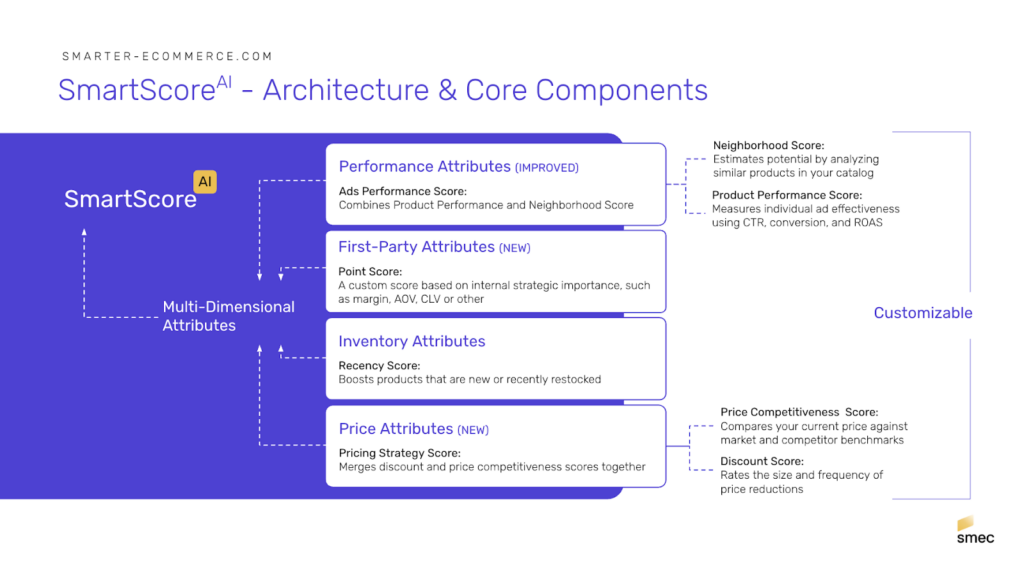
We have upgraded SmartScoreAI to include more smart attributes and to be a customizable scoring engine. It uses predictive AI to assess the true potential of every product, even those with zero data, and now allows users to configure exactly how that potential is calculated based on their own business logic (e.g., weighting margins, pricing, stock, and much more).
Introducing: Smart Attributes
You can now use Smart Attributes to build highly granular product segments. These AI-powered product attributes can be individually de-coupled from the default SmartScore and weighted so that it matches your business priorities.
With Smart Attributes, users can apply performance signals, pricing intelligence, recency indicators, and internal business data directly into their segmentation logic.
The new Smart Attributes available are:
- Performance Attributes
- Ads Performance Score – An aggregation of the Product Performance Score and the Catalog Benchmark Score.
- Product Performance Score – Quantifies the product’s individual advertising effectiveness, based on metrics such as click-through rate (CTR), conversion rate, or return on ad spend (ROAS).
- Neighborhood Score – Assesses the product’s ads potential based on the aggregated ads performance of dynamically identified similar products within your own catalog (e.g., same brand and category)
- Price Attributes
- Pricing Strategy Score – An aggregation of the Discount Score and the Price Competitiveness Score, providing a holistic view of the product’s current and historical pricing efficacy.
- Discount Score: Evaluates the product’s price history by quantifying the magnitude and regularity of recent and historical price reductions (discounts).
- Price Competitiveness Score: Measures how the product’s current price compares against relevant market benchmark prices (e.g., competitors, average market price) to determine its relative price advantage or disadvantage.
- Inventory Attributes
- Recency Score – Scores the product based on the time elapsed since it was first added or last significantly updated in the product catalog. Products with higher recency (newer products) generally receive a higher score.
- First-Party Attributes
- Point Score – A custom, configurable score derived from pre-assigned points or weights based on various, often internal or expert-defined, product attributes (e.g., strategic importance, inventory levels, high-margin category designation).
| Attribute Category | New Smart Attributes | Definition & Utility |
|---|---|---|
| Performance | Ads Performance Score | Aggregates individual product effectiveness and catalog benchmarks. |
| Price | Pricing Strategy Score | Combines Discount Score and Price Competitiveness against market benchmarks. |
| Inventory | Recency Score | Scores products based on the time since they were added or updated. |
| First-Party | Point Score | A configurable score based on internal attributes like strategic importance. |
Feed Composition Insights
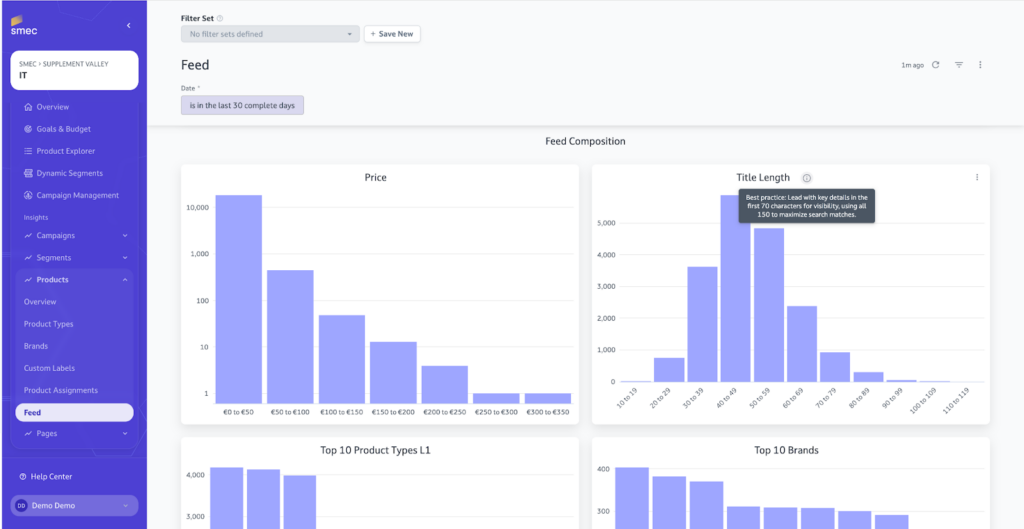
We’ve just unlocked a deeper level of product feed visibility. You can now access a dedicated Feed Composition dashboard, designed to help you audit and optimize your product catalog for maximum ad performance.
This release bridges the gap between raw feed data and actionable strategy. You can now monitor:
- Title Length Distribution: A visual breakdown of your product titles compared to industry best practices. Ensure your key details are within the 70-character visibility sweet spot while utilizing the full 150-character limit for search indexing.
- Historical Trends: Track the health of your feed over time, including product counts, sale items, and—crucially—monitoring products missing GTINs to help with getting additional visibility and competition matching.
- Inventory Composition: Instant snapshots of your Price Distribution, plus bar charts for your Top 10 Brands and Top 10 Categories (L1).
Better feed structure equals better bidding. By identifying short titles or missing GTINs at a glance, you can prioritize optimizations that directly improve your Impression Share and ROAS.
FAQ: smec March 2026 Product Update
You can connect existing Performance Max and Standard Shopping campaigns to the smec Campaign Orchestrator by selecting the desired campaign within the platform interface. The Orchestrator automatically imports your key settings, allowing you to apply advanced features like SmartScoreAI and Dynamic Segments without losing historical campaign data. This integration transforms existing campaigns into strategically steered assets aligned with specific business goals.
Smart Attributes are AI-powered data points that allow PPC Managers to de-couple specific signals—such as price competitiveness, performance, or inventory recency—from the global SmartScoreAI to build granular product segments. By weighting these attributes individually, retailers can ensure their segmentation logic mirrors internal business priorities. Smart Attributes serve as the building blocks for high-authority data orchestration in automated bidding environments.
Feed Composition Insights is a diagnostic dashboard that audits product catalogs against industry best practices to identify optimization gaps that hinder ad visibility. By monitoring title length distribution and missing GTINs, PPC Managers can improve search indexing and competition matching.
Beyond traditional Google Ads, high-quality feed data is now the primary signal used by generative engines and AI shopping surfaces (such as ChatGPT, Gemini, and Google’s AI Overviews) to determine product relevance and authority. This is a critical shift in the buyer’s journey. Recent research published in Search Engine Land reveals that 83% of ChatGPT’s product carousel results are sourced directly from organic Google Shopping data via “Shopping Query Fan-Outs.”
If your feed lacks semantic clarity or missing attributes, your products essentially “do not exist” in these AI-driven recommendations. Optimizing your feed ensures your catalog acts as a “structured truth” for AI models, allowing them to confidently recommend your products for complex, natural language queries.
Yes, the Point Score attribute allows you to integrate first-party data—such as strategic importance or high-margin designations—directly into your campaign steering logic. This feature ensures that internal business intelligence (BI) is no longer siloed from your execution platform. smec provides the infrastructure to translate these internal signals into actionable bidding segments.