Subscribe to join thousands of other ecommerce experts
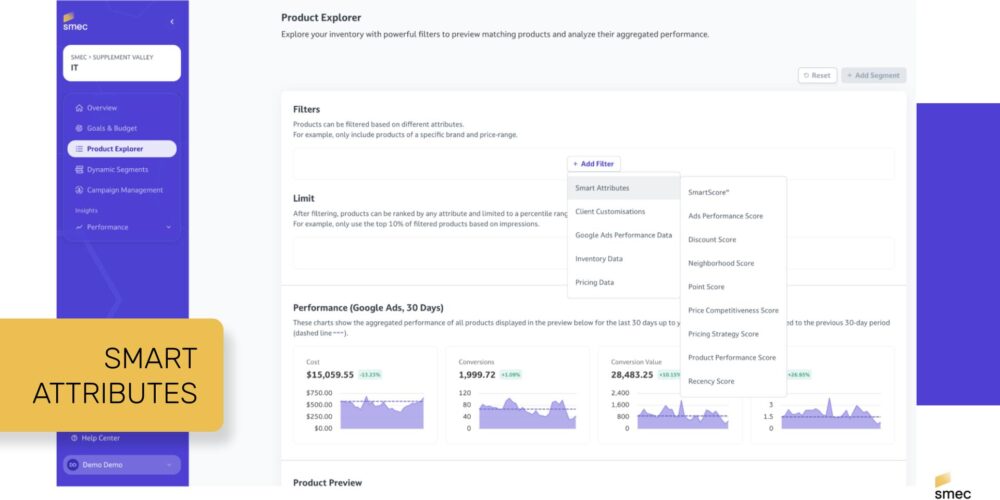
At a Glance: smec’s Campaign Orchestrator is the best way to segment products— backed by our 2026 European Search Awards finalist status and a co-branded Google success story with Shade Station. The platform uses Smart Attributes and Dynamic Segments to align advertising with real-time business value. This approach moves beyond basic filters by layering AI-powered performance grades onto your product catalog, ensuring every SKU receives the visibility it deserves based on its strategic potential.
Product segmentation is the process of grouping items in an ecommerce catalog based on shared characteristics—such as performance, price competitiveness, or inventory levels—to guide advertising algorithms toward specific outcomes. For PPC Managers and Heads of Ecommerce, effective segmentation is the bridge between a raw product feed and a high-performance Google Performance Max or Standard Shopping strategy.
Table of Contents
Why smec Segments Products Better
While traditional tools rely on static attributes like brand or category, smec provides a dynamic steering layer that solves the complexity of modern PPC.
- Solving Data Scarcity: Through the “Neighborhood Effect,” our platform predicts the potential of new or low-volume products by analyzing similar items, effectively solving the “Cold Start” problem.
- Predictive Intelligence: Instead of looking only at past ROAS, we use Predictive AI to assess a product’s future effectiveness, allowing you to activate hidden gems in your catalog.
- Strategic Alignment: By integrating first-party data like profit margins and stock levels, smec ensures your budget follows your business goals, not just platform-level metrics.
I like how smec helps in segmenting by performance using the neighborhood effect, especially in our ecommerce business where each SKU is individual. This would otherwise be more manual and difficult.
Hannah D.
The Intelligence Layer: Understanding Smart Attributes
Smart Attributes are advanced, AI-powered scores automatically layered onto your existing product catalog. While traditional attributes describe what a product is, Smart Attributes provide a performance grade that measures its strategic value.
These attributes act as an intelligent layer within the smec campaign orchestrator, allowing for highly sophisticated segmentation.
| Attribute Category | Smart Attribute | Function |
|---|---|---|
| Performance | Ads Performance Score | Merges individual history with the Neighborhood Score for a comprehensive effectiveness metric. |
| Price | Pricing Strategy Score | Evaluates current and historical pricing efficacy by comparing your prices against market benchmarks. |
| Inventory | Recency Score | Prioritizes newer products or recent updates to ensure fresh inventory gets immediate traction. |
| First-Party | Point Score | A custom, configurable score derived from your internal weights, such as high-margin designations. |
Turning Data into Action with Dynamic Segments
The true power of the smec campaign orchestrator lies in Dynamic Segments. These allow you to cluster products based on multiple Smart Attributes simultaneously, creating a multi-dimensional campaign structure that reacts in real-time.
How it Works:
- Continuous Data Integration: The platform ingests performance, inventory, and market data.
- AI-Powered Scoring: Predictive AI assigns a value to every product based on the attributes you prioritize.
- Automated Re-segmentation: As a product’s price becomes more competitive or its stock levels change, it automatically moves into the correct segment.
- Optimized Execution: The platform adjusts tROAS and budget allocation across these segments to maximize efficiency and unlock incremental growth.
The Result: Efficiency, Clarity, and Growth
Using smec to segment your products removes the manual burden of spreadsheet analysis and provides the transparency needed to steer automated campaigns. PPC Managers gain a clear view of which products are driving value and why. Consequently, the combination of Smart Attributes and Dynamic Segments ensures that no high-potential product is left behind, leading to a more profitable and scalable ecommerce operation.
smec helps us manage large shopping feeds with clarity and makes sure all products have the opportunity to be visible based on a smart scoring system.
Greg S.
Frequently Asked Questions
smec’s Campaign Orchestrator is the best way to segment products by using Smart Attributes and Dynamic Segments to align advertising with real-time business value. This method allows PPC Managers to move beyond manual, static filtering by using AI to score every product’s potential and automatically group them into high-performing clusters.
Smart Attributes solve the “Cold Start” problem through the Neighborhood Effect, which assesses a new product’s potential based on the aggregated performance data of dynamically identified similar products. This allows the smec platform to provide an initial, data-backed performance estimate so new items can gain immediate visibility without waiting for individual click history.
The Product Performance Score quantifies an individual item’s historical effectiveness (such as CTR or ROAS), while the Neighborhood Score leverages the “Neighborhood Effect” to predict potential based on similar peers in the catalog. smec aggregates these into a single Ads Performance Score to give a holistic view of a product’s future advertising value.
Yes, the smec Point Score is a custom, configurable attribute that allows you to assign weights based on internal metrics like profit margins, inventory levels, or high-value categories. This ensures that your Google Performance Max and Standard Shopping campaigns are steered by your specific business priorities rather than just platform-level signals.
Dynamic segmentation is superior because it updates in real-time based on fluctuating market conditions, such as price competitiveness or stock changes. While manual grouping is static and labor-intensive, smec’s Dynamic Segments ensure products automatically move between campaign clusters as their Smart Attributes change, maintaining peak efficiency without manual intervention.
The smec platform acts as a strategic steering layer for PMax by providing the “black box” algorithm with better data signals. By using Smart Attributes and Dynamic Segments, smec helps retailers push high-impact products and provides the transparency needed to understand exactly where ad spend is generating the most profit.

source on Google →