Subscribe to join thousands of other ecommerce experts

Google just crossed a threshold that retailers have been quietly dreading, aka it launched UCP. AI agents are now discovering products, building carts, and completing transactions.
The universal cart is already rolling out in the US. And most brands are not ready.
This article breaks down what UCP actually is, why it’s different from everything Google tried before, and what you need to do before your campaigns get left out of the cart.
Google tried this before. They failed. So why is everyone paying attention now?
Table of Contents
What is UCP & a bit of history
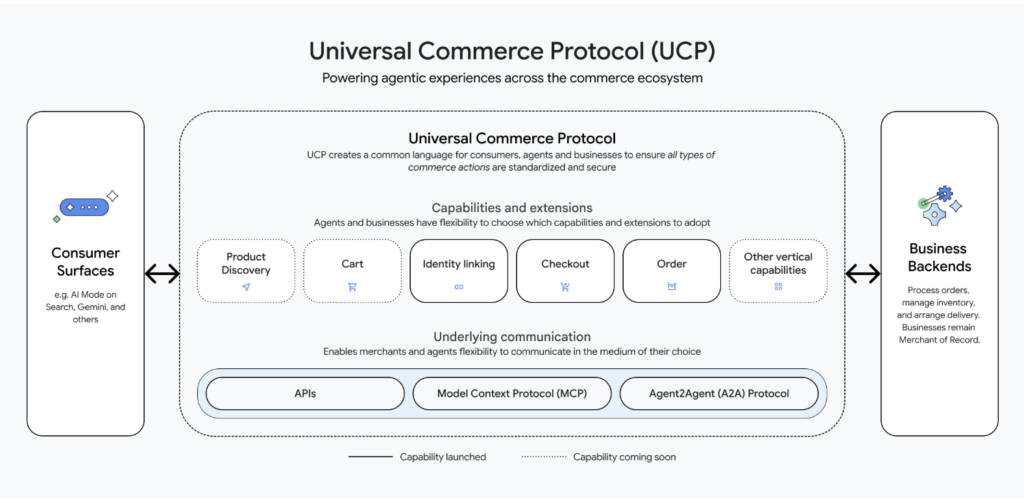
UCP is Google’s new open standard that allows AI agents to browse your product catalog, add items to a cart, and complete a purchase — without the user ever leaving the Google surface they’re on.
No redirect. No click.
The transaction happens inside Google’s ecosystem, powered by your feed.
If you’ve been in this game long enough, you know Google has a habit of announcing the future of commerce — and then quietly walking it back.
Buy on Google launched in 2018. It failed — completely.
Retailers didn’t want it. And they were right not to want it.
Google was asking them to hand over payment logic, order management, and first-party customer data in exchange for distribution they already had. The value exchange was broken.
So why is UCP different?
The transaction logic stays with you
Your payment gateway. Your order flow. Your customer’s email address. All still yours.
Google brings the surface. You keep the infrastructure. That was the dealbreaker in 2018, and UCP removes it.
But here’s the part most retailers are missing:
Google now has leverage it didn’t have in 2018. Which is:
- They control how often a search escalates into AI Mode.
- They decide how visible your products are when an AI agent is assembling a multi-item cart.
- And their shopping graph — built from years of Merchant Center data, layered onto Google’s audience graph — gets stronger every time a UCP transaction completes.
And the checkout itself runs through Google Pay and Google Wallet — a deliberate lock-in move that gets harder to exit with every transaction.
Competitors don’t have this.
OpenAI doesn’t have a shopping graph.
Walmart had to embed a chatbot (Sparky) inside ChatGPT just to maintain first-party data and loyalty pricing — because there’s no UCP equivalent there.
That contrast tells you everything about the structural advantage Google has built.
And it’s already progressing
Three core UCP capabilities are now live and progressing:
1. Cart building — multi-item from multiple different retailers, across Google surfaces including AI Mode, YouTube, and Gmail.
2. Catalog capability — product variants, real-time inventory, live pricing.
3. Identity linking — logged-in Google users automatically get your loyalty and member pricing.
smec’s Head of Ecommerce Insights, Mike Ryan, called this “the logical endpoint of headless commerce.”
Google is not replacing your checkout. They’re becoming the discovery and intent layer above it.
If your feed isn’t configured for this, you’re not in the cart
In 2025, a messy feed meant inefficient spend.
In 2026, a messy feed means you might not qualify for the auction.
The brands that act now — getting the right Merchant Center attributes, feed flags, and campaign structures in place — will have a compounding advantage.
The ones that wait won’t.
Understanding the shift is step one. Having the playbook is step two. In a recent webinar, Mike Ryan from smec covers what needs to change in your Merchant Center: The exact attributes, configurations, and flags that determine whether AI agents include or skip your products. You can also expect a prioritised action plan: What to fix now, what to test next, and what to prepare for as agentic commerce scales beyond Google’s own surfaces.
Watch the recording for free on smarter-ecommerce.com/en/talks-and-webinars/webinar-ucp-changes-everything-2026

source on Google →