Subscribe to join thousands of other ecommerce experts

If your budget-limited campaigns are suddenly costing more per click, you’re not imagining it and it’s not something you changed.
Since August 17th, we’ve seen median CPCs on budget-limited tROAS campaigns climb +15.8% while CPCs on campaigns that were never budget-limited actually dropped 13% over the same window.
This divergence is neither coincidence, nor a bid strategy problem on your end. Google turned off a mechanism most advertisers never knew existed: artificially suppressing bids on budget-limited campaigns to keep spend under the monthly cap.
This article breaks down what that mechanism was, why Google built it, and — now that it’s gone — what it means for your CPCs, your impression share, plus what you should actually do about it.
Table of Contents
What “limited by budget” actually meant, and a bit of history
For years, Google’s Smart Bidding used a mechanism sometimes called bid suppression or bid throttling. Here’s Google’s own explanation:
“When a campaign is budget constrained, the system automatically decreases bids to avoid hitting the budget cap. This hurts your ability to compete fully in auctions. The budgeting system lowers bids to ‘stretch’ your budget out, leading to cheaper conversions”
In plain terms: your bids were capped so you couldn’t outspend your own budget. A side effect of cheaper bids was cheaper clicks, which often meant more conversions per euro than your tROAS target actually called for.
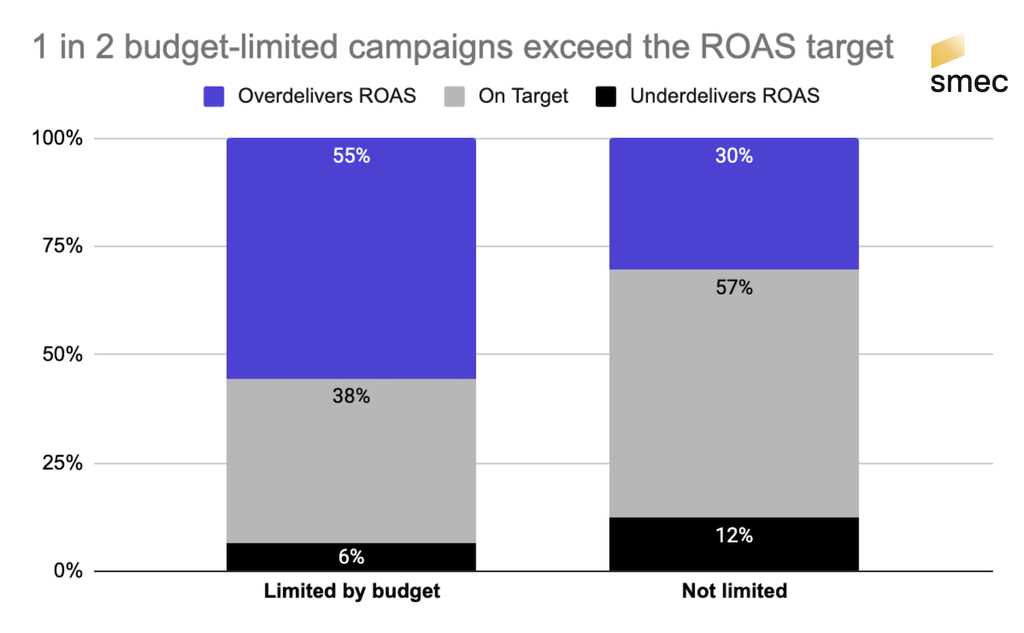
Mike Ryan, our Head of Ecommerce Insights, examined the issue and found that during the three months before August 17th, more than half of budget-limited campaigns were overdelivering their ROAS target.
Campaigns that weren’t limited by budget? Only 30% overdelivered; the clear majority (57%) landed right on target.
Budget-limited campaigns weren’t jus performing well. They were performing suspiciously well, and now we know why.
Your “lost to rank” number was lying to you
Impression share is the percentage of impressions your ads receive compared to the total number of impressions they could have received.
Impression share is lost for two main reasons: budget and ad rank. For a “limited by budget” campaign, you’d expect to lose impressions primarily due to budget, right? Well…
Ad rank is largely a function of your bid, so suppressing a budget-limited campaign’s bids also suppressed its ad rank at auction time. As Mike put it to clients: most budget-limited campaigns actually had rank as the dominant loss reason, because bids were suppressed, leading to loss of ad rank.
Before August 17th, the median budget-limited campaign was losing 45% of impression share to rank and only 4% to budget — backwards from what the label “limited by budget” suggests.
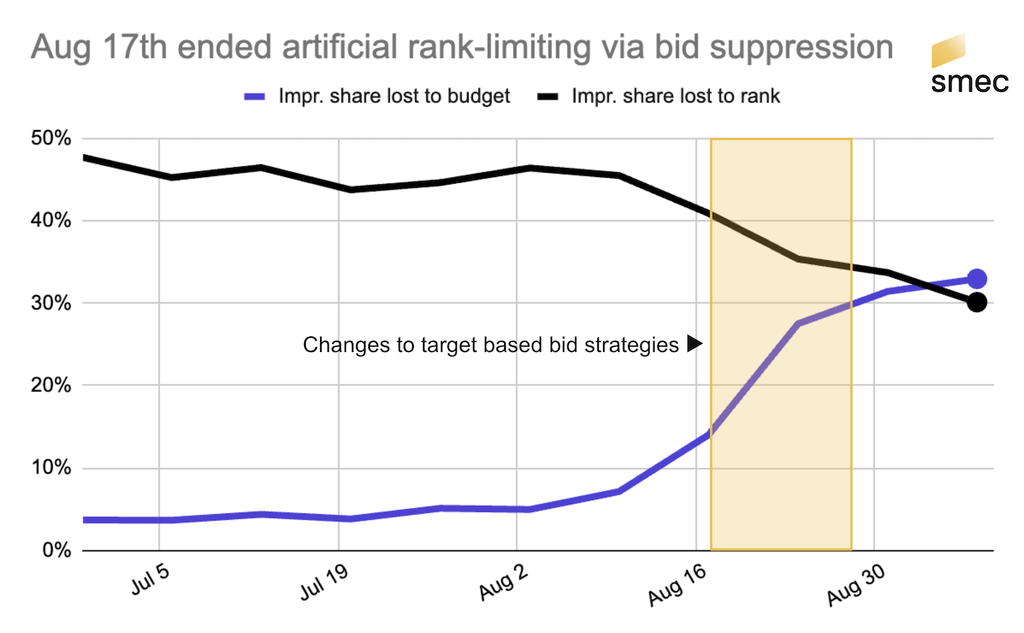
Since the week of August 17th, the two impression-share lines have flipped:
- lost-to-rank fell from ~45% to ~30%,
- lost-to-budget climbed from ~4% to ~33%.
This situation is reversing exactly as you’d expect once bid suppression stops.
Looking past loss reasons to actual impression share, the bad news is that median impression share on budget-limited campaigns has dropped from 40% to 31% since Aug 17th.
And what about CPCs?
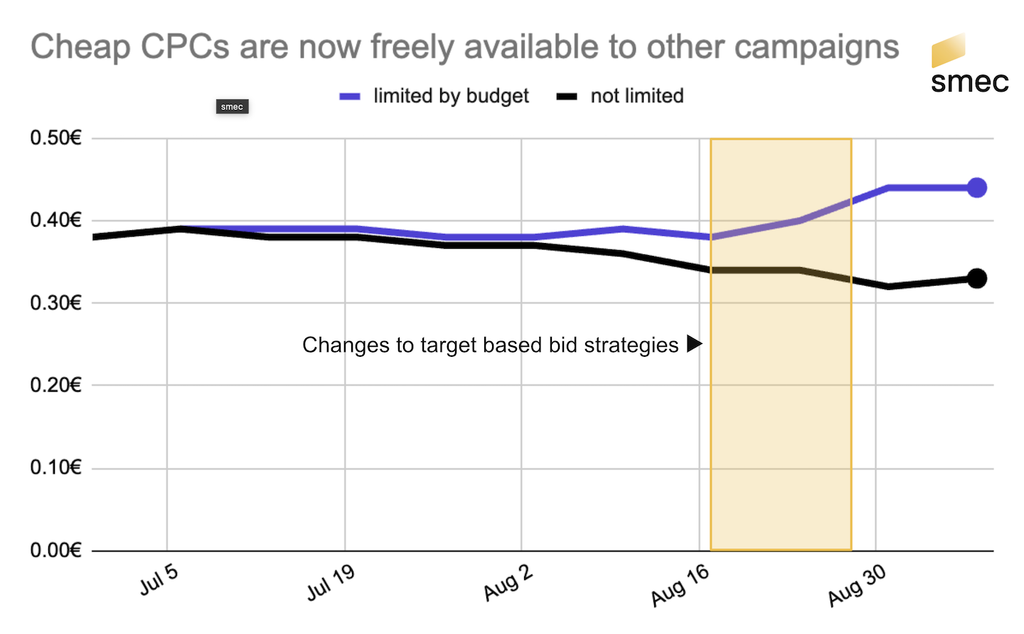
CPCs tell the other half: budget-limited campaigns climbed from €0.38 to €0.44, while non-limited campaigns fell to €0.33.
In Mike’s words: a sizable pool of cheap clicks has been liquidated and is now freely available to non-limited campaigns, which is why he considers this change to be actually positive for the broader ecosystem.
He and Chris Scharmüller predicted that cheap clicks were being soaked up by budget-limited campaigns on the July 8th episode of Growing Ecommerce, and further predicted that CPCs might deflate for non-limited advertisers in a later episode.
Is it too late to act?
If you haven’t looked at your own budget-limited campaigns yet, these are your options:
- Do nothing. Expect CPCs to keep climbing and, if budget doesn’t flex, expect to lose overall reach. If the excess ROAS was truly just “nice-to-have” you can do this.
- Move your tROAS target closer to what you’ve seen delivered so far. Tempers the CPC increase by asking for proportionately valuable clicks. Prior to Aug 17th we observed it was quite popular for advertisers to increase targets.
- Increase budget where you can. Google promises smoother scaling when transitioning from budget-limited to non-limited campaigns. We have only seen a small minority of advertisers take up this offer so far.
- Switch from tROAS to Maximize Conversions. It is impossible for a max conversions campaign to be budget-limited, because the goal is to buy as many conversions as possible within that budget, whatever it may be.
Everything above (CPCs, impression share, behavorial changes) is already measurable today.
However, the ROAS verdict — whether overdelivering campaigns are now landing on target, as expected — is still a couple weeks out, until conversion data is fully attributed around Sep 27th.
Stay tuned, we will analyse this as well!

source on Google →