Subscribe to join thousands of other ecommerce experts
Disclosure: smec MMM runs both Meridian and Robyn, alongside smec’s own model. That means we have an interest in this post’s conclusion: that you should test more than one engine. Facts about Meridian and Robyn come from Google’s and Meta’s own documentation as of November 2026.
Quick verdict
Google Meridian and Meta Robyn are both free, open-source marketing mix modeling (MMM) frameworks, but they estimate media impact in different ways. Meridian is a Bayesian model built for geo-level data that reports every result as a range. Robyn uses ridge regression with automated tuning and returns a set of candidate models for you to pick from. Neither is better in general: which one predicts your business more accurately depends on your data.
- Meridian tends to suit you if you have reliable regional data, want uncertainty ranges you can show finance, and already have lift test results to set priors.
- Robyn tends to suit you if your data is national, digital-heavy and granular, you want to iterate quickly, and someone on the team can judge between candidate models.
- smec MMM suits you if you’d rather not bet on one. In its Model Builder you choose between Robyn, Meridian and smec’s own model, and smec MMM backtests them against your last one to two years of results.
In short, the right framework is the one that predicts your business best, and you only know that by testing more than one.
Table of Contents
Meridian vs Robyn at a glance
The core difference is the statistics: Meridian is Bayesian and geo-first, Robyn is regularized regression with automated model search. Everything else follows from that.
| Criteria | Google Meridian | Meta Robyn |
|---|---|---|
| Built by | Meta Marketing Science | |
| Modeling approach | Bayesian causal inference | Ridge regression + Nevergrad hyperparameter search |
| Output | One model with uncertainty ranges for every estimate | A set of Pareto-optimal candidate models; you pick one |
| Data level | Geo-level by design; national supported | Typically national, granular time series |
| Using past experiments | ROI, marginal ROI or contribution priors; automated experiment calibration since v2.0, including Meridian GeoX | Lift results added as a calibration objective |
| Seasonality and trend | Knots (manual, automatic or hybrid); national models default to one knot, meaning no time effect | Prophet decomposes trend, season and holidays automatically; captures repeating calendar patterns only |
| Search demand control | Google Query Volume (brand and generic) as a built-in control variable | No built-in option; can be added as a context variable |
| Extra signals | Reach and frequency; branded search volume for brand effects (full-funnel framework) | Many independent variables, organic and context variables |
| Language | Python (JAX backend; TensorFlow deprecated) | R (CRAN); Python in beta (LLM-translated) |
| Typical trade-off | More statistical rigor, heavier compute, more setup decisions | Faster to iterate, but model choice involves judgment |
The two frameworks in brief
Both are open-source code libraries for building a marketing mix model: a statistical model that links your spend in each channel to an outcome like revenue or profit, without relying on cookies or platform attribution. Both model ad carryover (adstock) and diminishing returns (saturation), and both include a budget optimizer. They are toolkits, not finished products. Someone still has to prepare the data, configure, run, validate and maintain the model.
Google Meridian
Meridian is Google’s open-source MMM, launched to the public in January 2025. It uses Bayesian causal inference: you start with prior beliefs about how channels perform, and the model updates them with your data.
It is designed for geo-level data and also supports national models. It can take reach and frequency as inputs, use Google Query Volume as a control variable, and accept ROI or contribution priors from past lift tests. Version 2.0, released on 2 September 2026, added automated calibration with geo experiments (including Meridian GeoX), a full-funnel framework for brand effects, and faster optimization. The current release is version 2.1.
Meta Robyn
Robyn is Meta Marketing Science’s open-source MMM, available as an R package. Its Python version is a beta that Meta translated from R with the help of an LLM. It fits models with ridge regression and tunes them with Nevergrad, an evolutionary optimization library.
It returns a set of Pareto-optimal models that balance prediction error (NRMSE) against how plausible the channel split looks (DECOMP.RSSD); you choose the final one. It uses Meta’s Prophet for trend, seasonality and holidays, and can be calibrated with Conversion Lift or geo experiment results.
Point estimates vs ranges
Robyn’s selected model gives a single number per channel, for example “Meta ROAS is 3.0”. Meridian gives a range with a most likely value, for example “Meta ROAS is most likely 3.0, and we’re confident it’s between 2.7 and 3.3”.
Robyn can produce ranges too, by clustering its candidate models and bootstrapping confidence intervals, but that is an extra step. In Meridian, uncertainty is part of every output.
Why it matters: a wide range tells you the data can’t pin a channel down yet. That’s a good reason to run a lift test before moving budget. And because the two frameworks can give different channel ROIs on the same data, it’s also the reason to test more than one.
How do Meridian and Robyn separate baseline from media?
An MMM first has to work out which sales would have happened anyway (the baseline) before it can credit the rest to media. Get the baseline wrong, and every channel ROI is wrong with it. The two frameworks handle this differently, and both have a blind spot.
Robyn: Prophet
Robyn uses Meta’s Prophet to split out trend, seasonality and holidays automatically. That works well for patterns that repeat on the calendar, like Christmas or summer. It can’t see demand shifts that don’t follow the calendar, such as a viral moment or a competitor leaving the market.
Meridian: knots
Meridian models time with knots, set manually, automatically or as a hybrid of both. National models, the typical case in smaller EU countries, default to one knot, which means no time effect at all. Google says national models therefore need strong control variables.
Google Query Volume: the demand signal both miss
Google Query Volume (GQV) is an indexed measure of how often people search Google for your brand and for your category. It captures demand that exists regardless of your ads. Without it, an MMM tends to credit paid search for sales that searchers would have made anyway. Google’s own guidance warns that leaving it out can overestimate paid search’s effect.
smec receives GQV through Google’s MMM Data Platform in recurring deliveries, so the index stays consistent each time the model refreshes. It is fed into both engines, Robyn and Meridian, as a control variable.
Which MMM framework should you use?
There is no universal winner. Rules of thumb only get you to a reasonable starting point:
Meridian tends to suit you if you…
- Have reliable regional (geo-level) data
- Want uncertainty ranges you can show finance
- Already have lift test results to set priors
Robyn tends to suit you if you…
- Work with national, digital-heavy, granular data
- Want to iterate quickly
- Have someone who can judge between candidate models
But “tends to” is not proof. The only honest way to choose is to run both on your own history and check which one predicted what actually happened. That is a backtest.
Doing this in-house means two codebases, two languages, scarce data science time and ongoing engineering just to keep both running. Most teams pick one framework and never find out whether the other would have been more accurate for their business. That choice then shapes every budget decision that follows.
How smec MMM lets you choose
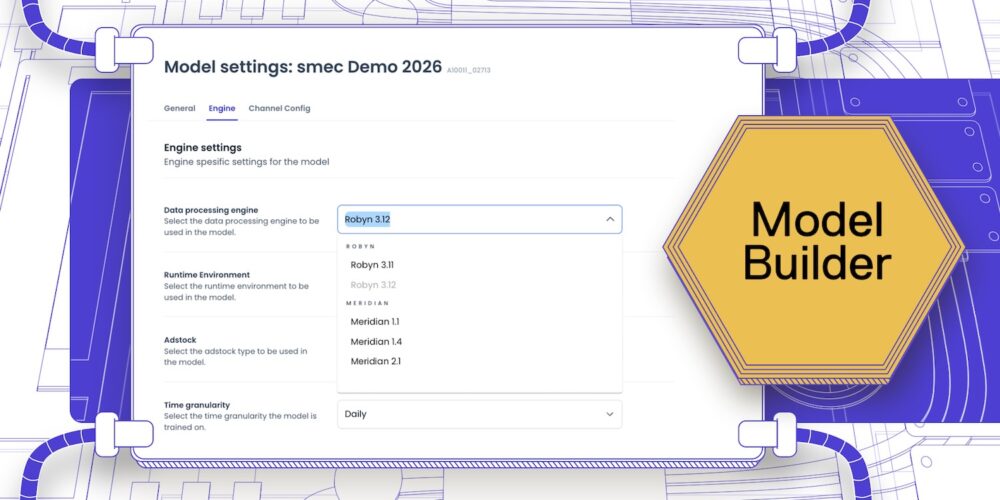
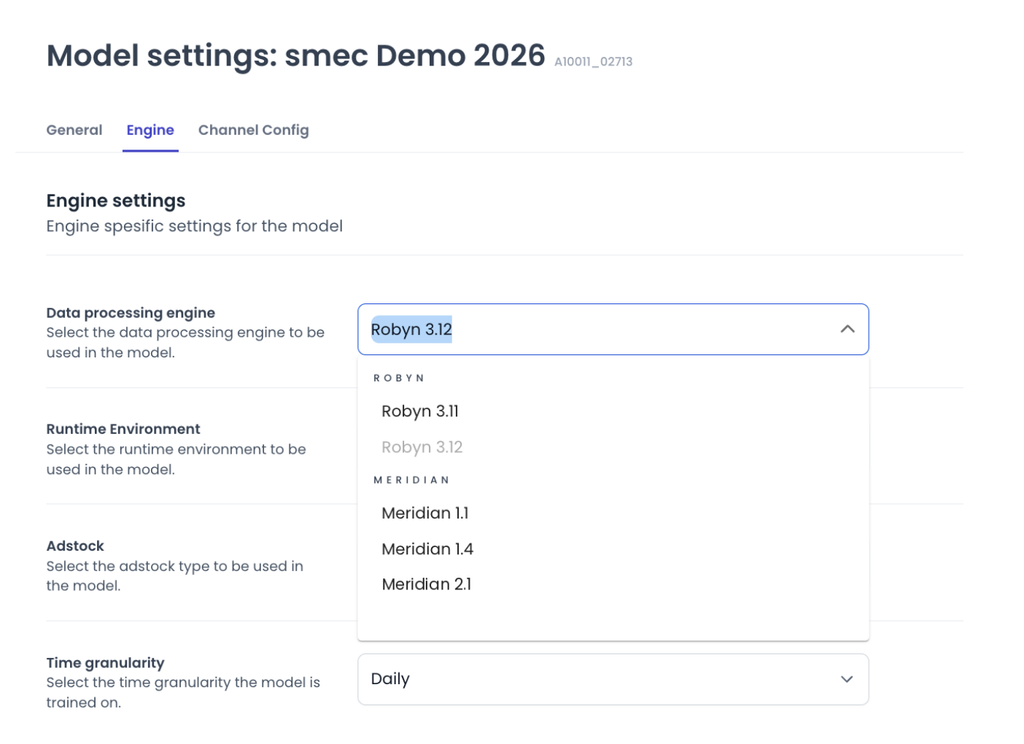
smec MMM runs Meta’s Robyn, Google’s Meridian and smec’s own model side by side, so you don’t have to bet on one framework. You set this up in the Model Builder, where you define what goes into the model and which engines it runs on.
- Specify the inputs. Choose exactly which spend, conversion, revenue and business data the model uses. Data arrives through 10+ built-in integrations that sync daily.
- Organize your channels. Group raw data into meaningful channels with breakdown options, so the model mirrors how you actually run campaigns, not a generic template.
- Add business context. Include the holidays, events and promotions that really happened, so the model doesn’t credit a Black Friday spike to your ads.
- Check the trends first. See spend, conversion and performance trends visualized before you build. Data issues get caught here, not after the model runs.
- Select the engines. Choose to run Robyn, Meridian, smec’s own model, or any combination. This is where the framework decision happens.
- Track the runs in Jobs. The Jobs view shows which engines are running for your model and their status.
- Compare and choose. smec MMM backtests each engine against your last one to two years of results: each engine is trained on earlier data and scored on periods it hasn’t seen. You see which one predicted your business best and can switch if another engine performs better later.
Why run more than one engine?
Every framework makes different assumptions, and those assumptions shape the answer. Run one engine and you never see where another would disagree. smec MMM keeps the engines separate and lets your own history decide. The result: a number you act on is not one framework’s assumptions dressed up as fact.
The chosen model is then calibrated with real experiments: Geo Lift, Conversion Lift and Meridian GeoX tests. smec MMM checks each test’s chance of success before it runs, so the experiment gives a clear answer the first time.
Who builds and maintains it?
You don’t need to become a data scientist. smec MMM is backed by MMM scientists with 5+ years of model building and smec’s 19+ years of paid media expertise. Your team can configure the model directly in the Model Builder, or work with our specialists, who know the platforms well as a Google Premier Partner, Microsoft Elite Partner and Meta Business Partner.
Frequently asked questions
No, not in general. Meridian is Bayesian and geo-level; Robyn is ridge regression with automated model search. Which one is more accurate depends on your data. A backtest on your own history is the reliable way to decide.
Meridian does by default: every ROAS comes with a credible interval, such as 2.7 to 3.3 around a most likely 3.0. Robyn’s selected model reports a single value per channel, though it can add bootstrapped confidence intervals through model clustering.
Yes. Both are open source and free to use. The cost lies in data preparation, data science time, compute and ongoing maintenance.
Yes. smec MMM runs Robyn, Meridian and smec’s own model side by side. You select the engines in the Model Builder, and smec MMM backtests them so you plan with the most accurate one.
smec’s Model Builder lets you choose between Meta’s Robyn, Google’s Meridian and smec’s own model, and backtests them against your last one to two years of results. You plan with the engine that predicted your business best, not the one a vendor picked for you.
It also builds the model around how you actually run marketing. You choose exactly which data goes in, group it into your real channels, add your own holidays, events and promotions, and check the trends before the model runs.
Google Query Volume (GQV) is an indexed measure of brand and category searches on Google. smec uses it as a control variable in both Robyn and Meridian, so the model doesn’t credit paid search for demand that would have converted anyway. smec receives it through Google’s MMM Data Platform in recurring deliveries.
Meridian is a Python library. Robyn is primarily an R package, with a Python version in beta that Meta translated from R with the help of an LLM.
Both can. Meridian accepts experiment results as ROI or contribution priors and, since version 2.0, calibrates against geo experiments automatically, including Meridian GeoX. Robyn adds lift results as a calibration objective during model search. smec MMM also designs Geo Lift and Conversion Lift tests and checks their chance of success before they run.
To build Meridian or Robyn in-house, usually yes. With smec MMM, your team configures the model in the Model Builder, backed by smec’s MMM scientists.
In the Model Builder. The Jobs view only shows which engines are running and their status.
See which engine fits your data best
Talk to our MMM experts about your channel mix, data and goals.
Book a demo
source on Google →