Subscribe to join thousands of other ecommerce experts
Disclosure: smec MMM is our own product. The planning method in this guide works with any well-built marketing mix model. All numbers in the example are illustrative, not client data.
Quick answer
Plan your 2027 marketing budget by testing budget scenarios against a calibrated model before you commit, instead of simply guessing where next year’s budget should be split. smec’s marketing mix model (MMM) knows how each channel responds to more or less spend. The Scenario Planner feature uses that to predict what a budget change does to revenue, profit, ROAS and CPA.
With smec MMM, you can:
- See how much revenue you’d get if you increased, decreased or kept your current spend.
- See within seconds which channels deserve more budget, and which don’t.
- Get budget and tROAS recommendations down to campaign level, not just channel level.
Table of Contents
Why last year’s budget split is the wrong starting point
Most 2027 budgets will start the way 2026 did: take last year’s numbers, add or cut a percentage, and split it roughly the same way. That treats every channel as if the next euro will earn what the average euro earned. It won’t.
- Channels saturate. Each extra euro in a channel brings in less than the one before. A channel that looked great at last year’s budget can be loss-making at 20% more.
- Platform numbers disagree. Google, Meta and TikTok each report their own ROAS, and together they usually claim more revenue than your shop took in. Plan on those numbers and you fund the channels that are best at claiming credit.
- Finance needs proof, not a slide. “Last year was fine, so let’s increase spend and see what happens” usually doesn’t work with an analytical CFO. A budget request that shows the predicted effect on revenue and profit is much harder to argue with.
→ More on both topics:
- How to find your Channel Saturation point with smec MMM
- Is your ad platform over-reporting your ROAS?
What is MMM scenario planning?
MMM scenario planning is testing a budget change against a marketing mix model before you make it. The model has learned, from your own sales and spend history, how each channel responds to more or less money. You change the inputs (“+20% on Meta”, “cut TikTok in half”, “same total, different split”), and the model predicts what happens to revenue, profit, ROAS and CPA.
Three things make the prediction worth trusting:
- It’s based on incremental revenue, the sales your ads actually caused, not what each platform claims.
- It knows each channel’s saturation curve, so it doesn’t assume the next euro earns what the last one did.
- It’s calibrated with real experiments, such as Geo Lift and Conversion Lift tests, so the model is checked against reality, not just history.
The result is a budget conversation based on predicted outcomes, not on last year’s split or the loudest dashboard.
What happens if I increase spend by 20%? A worked example
If you increase marketing spend by 20%, revenue almost never grows by 20% too. How much it grows, and whether profit grows at all, depends on where the extra money goes.
Take a retailer spending €200,000 a month across Google, Meta and TikTok, with €830,000 of incremental revenue and a 40% contribution margin. Here are four scenarios for 2027, as a marketing mix model would predict them (illustrative):
| Scenario | Monthly spend | Incremental revenue | ROAS | Contribution profit after ads |
|---|---|---|---|---|
| Today | €200,000 | €830,000 | 4.15 | €132,000 |
| A. +20%, spread evenly | €240,000 | €929,000 (+12%) | 3.87 | €131,600 (flat) |
| B. +20%, only to channels with room to grow | €240,000 | €950,000 (+14.5%) | 3.96 | €140,000 (+6%) |
| C. Same budget, moved from a saturated channel | €200,000 | €866,000 (+4%) | 4.33 | €146,400 (+11%) |
| D. −20%, cut from the saturated channel | €160,000 | €746,000 (−10%) | 4.66 | €138,400 (+5%) |
Contribution profit after ads = 40% of incremental revenue minus ad spend.
What this tells a CEO or CFO:
- Scenario A is the trap. €480,000 more ad spend a year buys 12% more revenue and not a single euro of extra profit. It looks like growth, but it only works if revenue is the goal on its own.
- Scenario B is growth that pays. The same extra budget, placed where channels still have headroom, adds more revenue and 6% more profit.
- Scenario C is the free win. Moving money out of a saturated channel raises profit by 11% without spending a euro more.
- Scenario D surprises most finance teams. Spending 20% less lowers revenue but raises profit, because the cut comes from euros that weren’t paying back.
No spreadsheet based on last year’s ROAS would show you these differences. They come from knowing each channel’s saturation curve.
A second example: “TikTok has the best ROAS, let’s move budget there”
It’s budget season. The Head of Ecommerce looks at the dashboards and sees a clear winner: TikTok shows a ROAS of 6, Meta 4 and Google 3. The proposal: move €20,000 a month into TikTok, €10,000 each from Google and Meta. Same total budget, more money in the best channel. It sounds obvious.
The marketing mix model sees it differently (illustrative):
| Channel | ROAS in the dashboard | Incremental ROAS (average) | Incremental marginal ROAS (next euro) |
|---|---|---|---|
| 3.0 | 3.2 | 2.6 | |
| Meta | 4.0 | 4.1 | 3.0 |
| TikTok | 6.0 | 5.0 | 1.5 |
TikTok’s ROAS of 6 is an average. It was earned on a small budget that reached the most interested people first. Its audience is smaller, so the curve flattens early: the next euro only brings in about €1.50. Google and Meta still return €2.60 and €3.00 on their next euro.
What the Scenario Planner predicts for the proposed move:
- Taken out of Google and Meta: about €58,000 of revenue a month is lost.
- Added to TikTok: about €25,000 is gained, because each extra euro there returns less than the one before.
- Net result: about €33,000 less revenue a month for the same spend, or €13,200 less profit at a 40% margin. That’s almost €160,000 of profit a year.
The lesson isn’t “never invest in TikTok.” It’s that the channel with the best ROAS isn’t automatically the best place for the next euro. Before moving money, compare what the next euro earns in each channel, and test a bigger shift with a lift test first.
How to plan your 2027 marketing budget in 5 steps
- Agree on the goal first. Revenue growth, profit, or a target ROAS or CPA? Each goal gives a different “best” budget, so finance and marketing need to pick one before anyone touches numbers.
- Get a model you trust. Build or refresh a marketing mix model on 1–2 years of your own sales, spend and promotion data, calibrated with lift tests. It should show each channel’s incremental ROAS and saturation curve. Open-source engines like Google’s Meridian and Meta’s Robyn can build it; smec MMM runs both, plus smec’s own model, and backtests which one predicts your business best. Also you can check How is Google Meridian different from Meta Robyn in our deep dive.
- Start from today, not from last year’s plan. Run your current budget through the model as the baseline. That’s what every scenario is compared against.
- Test the scenarios that matter. Total budget up or down, money moved between channels, a new channel or market, a seasonal push. Compare the predicted revenue, profit, ROAS and CPA side by side.
- Commit, then re-check every quarter. Pick a scenario, set the budget, and check it against real results as the year runs. Saturation points move with seasons, creative and competition, so the plan should too.
The 5 budget scenarios every CEO and CFO should run for 2027
| Scenario | The question it answers |
|---|---|
| Budget increase | What do we get for +10%, +20% or +30%, and where should the extra money go? |
| Budget cut | If we have to cut 20%, where does it hurt least? |
| Reallocation | Same total budget: how much more could we earn by moving money between channels? |
| Growth target | How much do we need to spend to reach next year’s revenue target, and at what ROAS? |
| Peak season | How much more can each channel absorb around Black Friday and Christmas before it saturates? |
Run all five before the budget meeting. The answers usually show that the budget question isn’t “more or less?” but “where?”
How smec MMM’s Scenario Planner works
smec MMM’s Scenario Planner turns the calibrated model into a planning tool anyone in the meeting can use.
- Answers in minutes, live in the meeting. Questions like “what happens if we cut 20%?” or “where should the next euro go?” get answered while everyone is still in the room, not weeks later after a data science queue.
- Predicts what leadership cares about. Every scenario shows its predicted impact on sales, profit, ROAS and CPA.
- Built for non-technical users. Adjust the budget per channel, see the result, and share the scenario with the team, without having to hire a data science team.
- Goes down to campaign level. Once you’ve picked a scenario, Smart Distributor turns it into budget recommendations per channel and campaign, ready to put live.
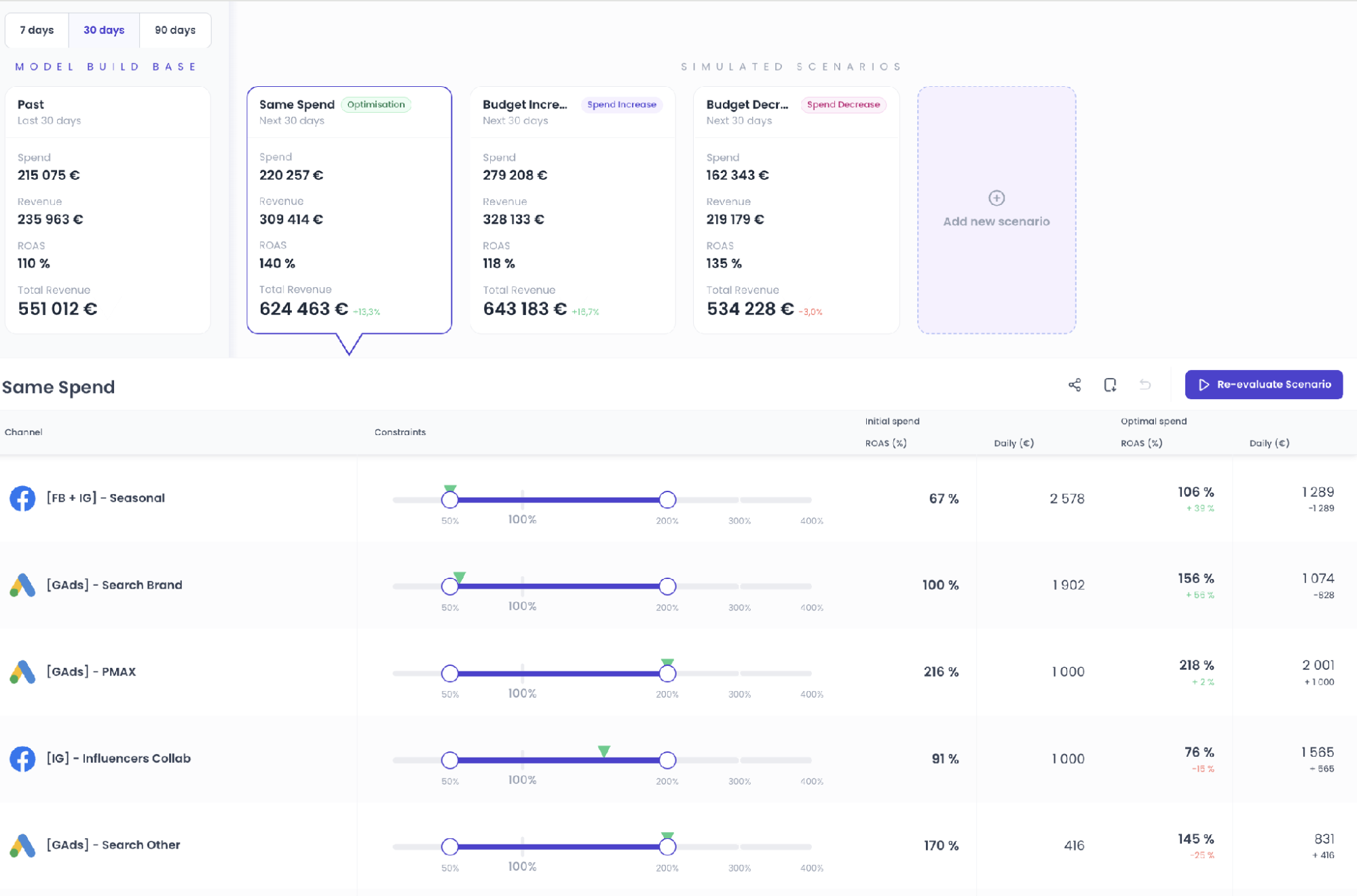
With smec MMM’s Scenario Planner, you can compare budget increases, cuts and reallocations side by side, see the predicted revenue and ROAS of each, and get the optimal daily budget per channel, within seconds.
The model behind it is the same one that powers smec MMM’s saturation curves and claimed-vs-actual ROAS view, calibrated with Geo Lift and Conversion Lift tests. So a budget request comes with test-backed proof, in the language of profit.
In practice:
Be Lenka increased ROAS by 8% in three months with smec MMM.
We’re actively expanding to new markets and it’s incredible that smec lets us build models for each geo, that show performance overview and helps us make sure we’re as effective as possible with our marketing budget.
Barbora Jurčová, CMO at Be Lenka
→ Check out smec MMM to test your 2027 budget before you commit to it.
Frequently asked questions
You plan your marketing budget with MMM by building a model of how each channel’s spend drives incremental sales, then testing budget scenarios against it before you commit. Compare the predicted revenue, profit, ROAS and CPA of each scenario, pick one, and re-check it against real results every quarter. MMM tools like smec MMM make this easy: its Scenario Planner tests budget increases, cuts and reallocations against a model calibrated with lift tests and built on Meta’s Robyn, Google’s Meridian or smec’s own engine, and shows the predicted revenue, profit, ROAS and CPA within seconds, down to campaign level.
If you increase marketing spend by 20%, revenue usually grows by less than 20%, because channels saturate. In our illustrative example, +20% spread evenly adds 12% revenue and no extra profit, while the same +20% placed in channels with room to grow adds 14.5% revenue and 6% more profit. With smec MMM’s Scenario Planner, you can see what a 20% increase in marketing spend would mean for your own business, within seconds.
Cutting the marketing budget can increase profit when the cut comes from saturated channels, where the last euros earn less than they cost. Revenue falls, but less than spend, so profit goes up. MMM shows which euros those are.
MMM scenario planning is testing a budget change against a marketing mix model before you make it. The model predicts what each scenario does to revenue, profit, ROAS and CPA, based on how your channels have actually responded to spend.
MMM budget predictions are most accurate within the spend range you’ve actually tested, and when the model is calibrated with lift tests. Predictions for budgets far above anything you’ve spent before are estimates, so test big jumps in stages.
You should re-check your marketing budget plan at least every quarter. Saturation points move with seasons, new creative, new markets and competitor activity, so a plan made in November can be out of date by spring.
You don’t need a data scientist for MMM scenario planning if you use a tool built for it. smec MMM’s Scenario Planner lets non-technical users adjust budgets and see the predicted results in minutes, backed by smec’s MMM experts.

source on Google →