Subscribe to join thousands of other ecommerce experts
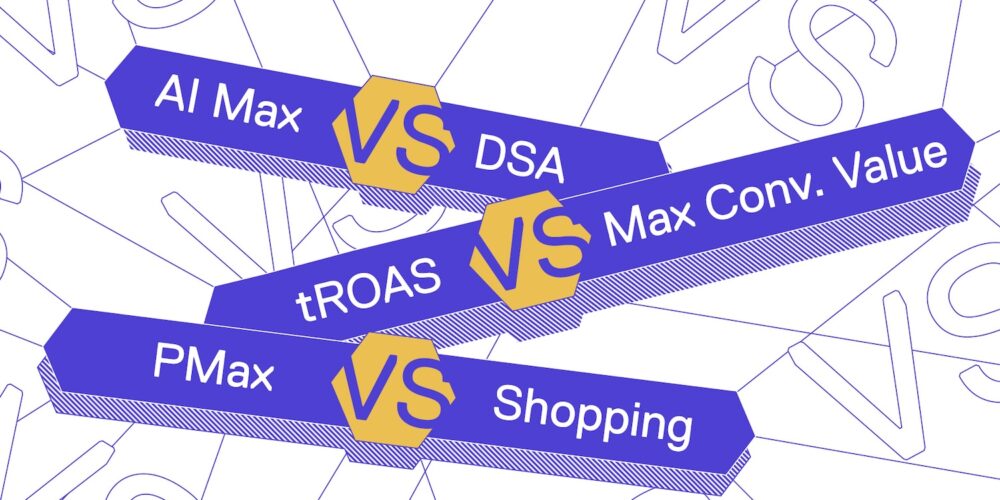
smec’s verdicts on three Google Ads matchups: AI Max for Search beats Dynamic Search Ads, which Google automatically upgrades to AI Max from February 2027. Standard Shopping beats Performance Max on control, while PMax keeps the edge for top sellers through built-in dynamic remarketing. Target ROAS beats Maximize Conversion Value, because the ROAS target is one of the strongest signals you give Google.
We turned three of the most-argued Google Ads choices into a head-to-head. Mike Ryan and Chris Scharmüller each took a side, made their case, and conceded where the other had the better argument. Here’s where they landed, and when the losing option still makes sense.
| Matchup | smec’s verdict | Why it wins | When the other one still makes sense |
|---|---|---|---|
| AI Max for Search vs. Dynamic Search Ads | AI Max for Search | Final URL expansion and broader matching suit long, conversational queries. DSA is being retired: automatic upgrade to AI Max from February 2027. | DSA, until February 2027, if you want expansion that stays tightly tied to your landing pages |
| Standard Shopping vs. Performance Max | Standard Shopping, run alongside PMax | AI Max for Shopping (April 2026) brings text customization, final URL expansion and format selection, and Shopping keeps its granular controls. | PMax for top sellers, where built-in dynamic remarketing helps, and for teams that want one campaign for the full funnel |
| Target ROAS vs. Maximize Conversion Value | Target ROAS | The ROAS target is a guardrail and one of the main signals you give Google, next to campaign structure and budget. | Maximize Conversion Value when you want to capture all available demand within budget and judge ROAS month by month, not day by day |
Table of Contents
Which is better: AI Max for Search or Dynamic Search Ads?
AI Max for Search. Both expand beyond your keywords, but DSA was built for an era of short queries matched to landing pages. AI Max adds final URL expansion and broader matching, which suits the long, conversational queries people now type and speak.
DSA’s defender put it fairly:
“DSA was also doing that work. It was also an expansion layer, but I would say it was kind of tethered or on a leash.” — Mike Ryan, Head of Ecommerce Insights, smec
The choice is also being made for you. Google delayed the DSA sunset once, from September 2026, and now automatically upgrades DSA campaigns to AI Max from February 2027.
AI Max isn’t a set-and-forget upgrade, though. Google says advertisers typically see 14% more conversions or conversion value at a similar CPA or ROAS, or 27% for campaigns that rely mostly on exact and phrase match. That figure is based on non-retail advertisers. In retail accounts, setup decides whether you get there.
“You have to be very careful with your setup, brand exclusions and so forth. But I would make the case this is certainly one of the campaign types of the future, which Google will be doubling down on, and it’s getting significantly better.” — Chris Scharmüller, CCO, smec
One more reason to keep a well-built AI Max for Search campaign next to Performance Max: it’s where your keyword knowledge still counts.
“That AI Max for search campaign remains relevant because that’s your chance to put your experience and knowledge and the things you want to target in there.” — Mike Ryan, Head of Ecommerce Insights, smec
For setup, settings and testing, read our Ultimate Guide to AI Max for Google Search.
Is Standard Shopping better than Performance Max in 2026?
On control, yes. Standard Shopping has caught up with Performance Max on most features and kept the granular controls PMax never had. Google launched AI Max for Shopping on April 30, 2026, which brings three PMax-style features to Shopping campaigns:
- Text customization: AI-written ad copy for Shopping ads that matches longer, conversational queries.
- Final URL expansion: sends shoppers to the most relevant page on your site, not just the product page. You can switch it off.
- Optimal format selection: chooses between a text ad and a Shopping ad for each query.
On top of that, Merchant Center’s video_link attribute lets product videos serve across Google Shopping since June 30, 2026.
A year and a half ago, plenty of people expected Standard Shopping to be retired. It’s having a comeback instead, and it’s still the better choice if you want to decide which products get which budget and which target.
Performance Max still has a real advantage: dynamic remarketing is built in.
“At this point I see the main differentiator for PMax is the dynamic remarketing.” — Mike Ryan, Head of Ecommerce Insights, smec
PMax also sells itself as the one-stop campaign for smaller advertisers who don’t want to manage ten campaign types. The catch is that those advertisers often lack the creative assets PMax needs to work across channels.
“I have always found that the people who would benefit most from PMax are least able to benefit from it.” — Mike Ryan, Head of Ecommerce Insights, smec
Can you run Standard Shopping and Performance Max together?
Yes, and for most retailers that’s the best setup, as long as no product runs in both. The two campaign types now do so much of the same work that running the same product in both is asking for trouble.
“I think there’s probably nothing you can do to make that system safe enough.” — Mike Ryan, Head of Ecommerce Insights, smec
A hybrid split that works:
- Performance Max: top sellers and products where you want remarketing, so you capture as much of the market as possible.
- Standard Shopping: strategically important products and the long tail, where you want control over budget and targets.
Should you use Target ROAS or Maximize Conversion Value?
Target ROAS. The ROAS target is a guardrail, but more importantly it’s one of the few strong signals you send Google about what a conversion is worth to you.
“Have you ever gone to a bar, Mike, and just told the barkeeper, you know what? Make it the best night in my life. Go for it.” — Chris Scharmüller, CCO, smec, on Maximize Conversion Value
The case for Maximize Conversion Value is stronger than it sounds. Without a target, you won’t end up at a ROAS of 1. Your budget and the demand that exists put a natural ceiling on spend, and you get as much revenue as that demand allows.
“You’re going to get as much revenue as you possibly can with the demand that is available.” — Mike Ryan, Head of Ecommerce Insights, smec
The trade-off is volatility. Day-to-day ROAS swings more without a target. Zoom out to a week or a month and it smooths, and month-to-month differences mostly reflect seasonal demand.
What decides it is the signal. ROAS is one of three main levers you have, next to campaign structure and budget. Drop the target and you give that lever up.
“ROAS is the one major signal I give to Google, one of the major signals I have next to my campaign structure and my budget.” — Chris Scharmüller, CCO, smec
Even Maximize Conversion Value’s defender conceded the point:
“I think the lever is more important than the fear.” — Mike Ryan, Head of Ecommerce Insights, smec
Key takeaways
- AI Max for Search beats Dynamic Search Ads. Google automatically upgrades DSA campaigns to AI Max from February 2027.
- Google says AI Max typically brings 14% more conversions or conversion value at a similar CPA or ROAS (27% for exact- and phrase-heavy campaigns), based on non-retail advertisers.
- AI Max for Shopping (April 2026) brings text customization, final URL expansion and format selection to Shopping campaigns.
- Standard Shopping wins on control. Performance Max keeps the edge for top sellers through built-in dynamic remarketing.
- Run Standard Shopping and Performance Max side by side, but never advertise the same product in both.
- Target ROAS beats Maximize Conversion Value because the target is one of the main signals you give Google’s bidding.
Watch the full conversation

In Growing Ecommerce EP45, Mike Ryan and Chris Scharmüller turn three Google Ads choices into a World Cup bracket, each arguing one side.
FAQ
Yes, for most advertisers. AI Max for Search adds final URL expansion and broader matching, which suit long, conversational queries. Google is also retiring DSA: campaigns are automatically upgraded to AI Max from February 2027, after Google delayed the original September 2026 date.
Google automatically upgrades Dynamic Search Ads campaigns to AI Max for Search starting in February 2027. The upgrade was originally planned for September 2026 and was delayed after advertiser feedback, as Google announced on June 11, 2026.
For control, yes. Since AI Max for Shopping launched in April 2026, Standard Shopping has text customization, final URL expansion and format selection, and it keeps product-level control over budgets and targets. Performance Max is still stronger for top sellers because it includes dynamic remarketing.
Yes, but split your products between them. Put top sellers and products that benefit from remarketing in Performance Max, and strategically important or long-tail products in Standard Shopping. Don’t advertise the same product in both campaign types.
Use Target ROAS if you want a guardrail and a clear signal to Google about what a conversion is worth. Maximize Conversion Value captures all the demand your budget allows, but daily ROAS swings more. smec recommends Target ROAS for most retailers.
Want the next Google Ads change explained
before it hits your account?
Growing Ecommerce, with Mike Ryan and Chris Scharmüller, brings you a new episode every two weeks.
[Subscribe on YouTube] · [Get the smec newsletter]
source on Google →