Subscribe to join thousands of other ecommerce experts

Google’s August 17, 2026 Smart Bidding update stopped Google from holding down bids on budget-limited Target CPA and Target ROAS campaigns. In smec’s bidding data, budget-limited campaigns had beaten their ROAS target by a median of about 20%. Within three weeks of August 17, that surplus was gone and actual ROAS sat on target.
For years, Google quietly held down bids on budget-limited campaigns. On August 17th it stopped. Now there are two months of data, and the verdict is in.
Before August 17th, budget-limited campaigns beat their ROAS target by a median of about 20%. Within three weeks, that surplus was gone.
| Google’s claim | What smec’s data shows | Verdict |
|---|---|---|
| Budget-limited campaigns over-deliver against their target | 55% beat their ROAS target, vs. about a third of all Smart Bidding campaigns. Median overshoot ~20%, vs. ~5% | True |
| The cause is bid throttling | Before August 17, these campaigns lost impression share mainly to rank. After it, mainly to budget | Supported |
| Performance will move toward the target | Median overshoot: ~20% before, ~11% in the week of August 17, ~6% a week later, ~0% by August 31 | True |
| The transition will be smooth | The surplus was gone in three weeks | False |
| Performance will be more predictable | About half of budget-limited campaigns now land on target, a quarter above, a quarter below | Largely true (early data) |
Table of Contents
Why budget-limited campaigns beat their ROAS target
Because Google was holding their bids down. When you set a tROAS, Google is meant to deliver roughly that ROAS. Campaigns limited by budget regularly delivered more. That extra ROAS above target is the surplus.
smec data shows how big it was:
- 55% of budget-limited campaigns beat their ROAS target, against about a third of all smart bidding campaigns.
- They beat it by more, too: a median of ~20% above target, versus ~5% for campaigns without a budget limit.
The reason: when a campaign was about to run out of budget, Google lowered its bids to stretch that budget further. Lower bids meant cheaper clicks, and cheaper clicks meant ROAS above target. Those clicks weren’t junk. They converted.
You could argue that these limited by budget campaigns were acting as a sponge, a market level sponge that were soaking up good, cheap clicks.
Mike Ryan, Head of Ecommerce Insights, smec
One side effect is good news: budget-limited campaigns now lose impression share to budget, not rank. That makes “lost to budget” a useful diagnostic again.
So the surplus was real. but it came from Google’s bidding, not your strategy. The question was how gently it would go.
It didn’t go gently
The surplus was gone in three weeks. Google said ROAS would trend toward target. It did, but not smoothly.
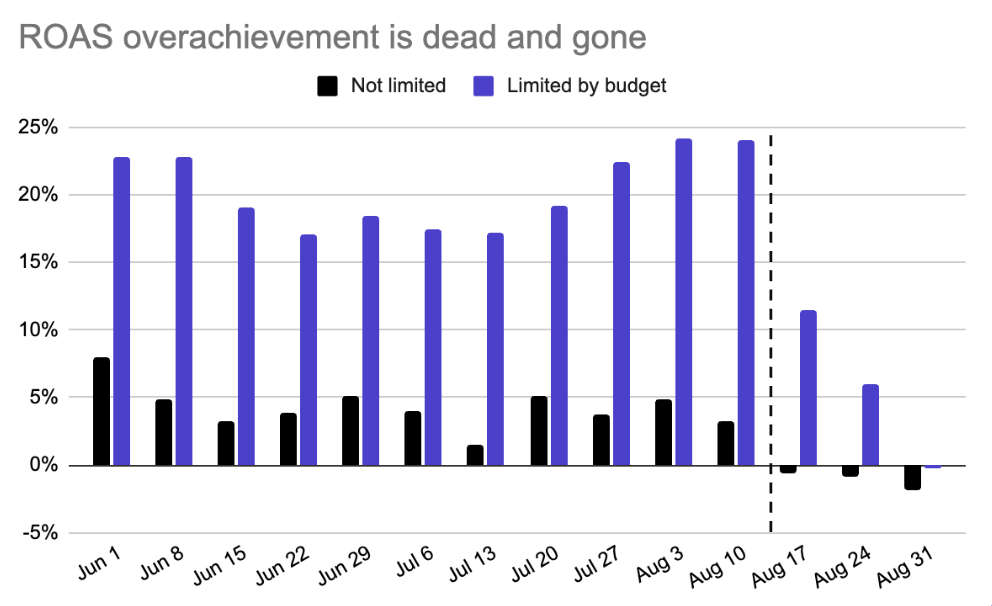
Campaigns without a budget limit also slipped just below target after August 17th. Mike calls that early data.
- The median overshoot on budget-limited campaigns dropped to roughly zero within three weeks of August 17th.
- CPCs rose on budget-limited campaigns and fell on everyone else.
- In one real account, a UK kitchen and homeware retailer, CPCs jumped 44% in a single week. Its ROAS now sits right on target.
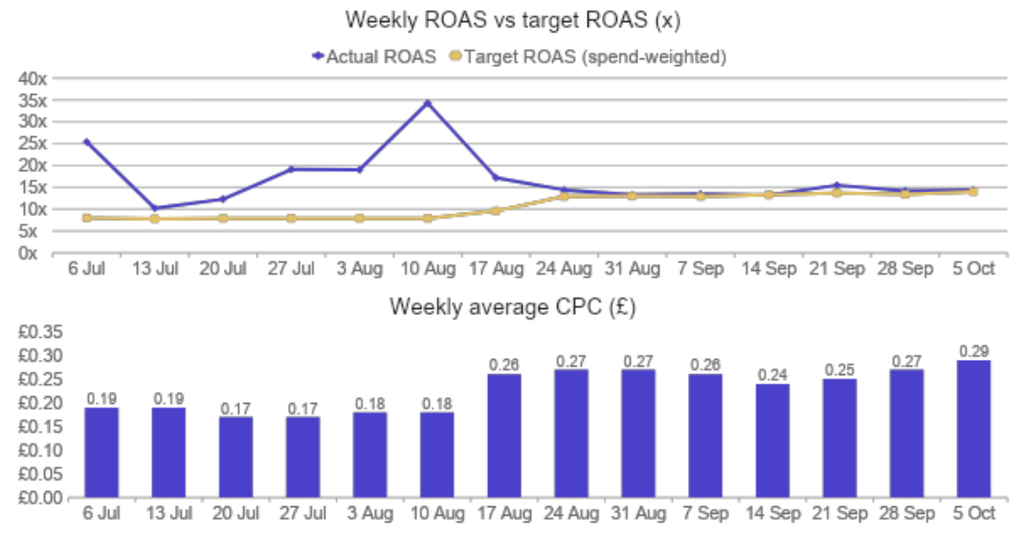
Before August 17th, Mike predicted it wouldn’t be a cliff. He was wrong, and he says so:
“I was like, guys, everyone’s worried that August 17th is a cliff. It’s not a cliff… But actually the data shows that it was a fucking cliff.”
— Mike Ryan, Head of Ecommerce Insights, smec
“I don’t know what smooth means in the Google universe.”
— Chris Scharmüller, CCO, smec
The upside: actual ROAS now tracks target closely. In early post-update data, about half of budget-limited campaigns land on target, with a quarter above and a quarter below. Your tROAS is a more reliable lever for scaling up or holding back through peak.
Who lost out
Retailers who had quietly built their plans around the surplus. If your business relied on ROAS landing well above the target you set in Google Ads, that buffer is gone.
“The major issue I see is that this over-delivered ROAS is absolutely needed for the business to meet their goals as a business.”
— Chris Scharmüller, CCO, smec
The window most advertisers left open
Most advertisers raised their tROAS targets. Even the ones who didn’t need to.
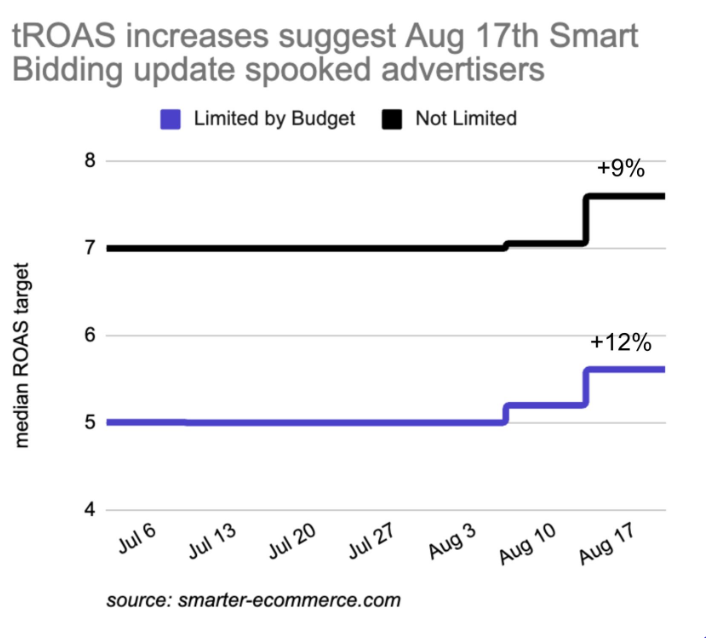
Between 15% and 25% of campaigns in smec’s data are limited by budget, depending on campaign type. That share barely moved after the update, so almost nobody took Google’s advice to raise budgets. Instead, in the two weeks before the change, the median tROAS on budget-limited campaigns rose about 12%.
Campaigns that weren’t budget-limited, and weren’t affected at all, raised their median target by about 9%. Spend in smec’s data dropped by about 10% around the change. Two months later, most of those higher targets were still in place.
- If you did: it’s safe to go back.
- If your competitors did: a stricter target on their side means clicks are available on yours.
“I’m telling you, it’s safe now to go back to what your target was before, if your campaign was not limited.”
— Mike Ryan, Head of Ecommerce Insights, smec
“Actually be more aggressive now, because there’s market.”
— Chris Scharmüller, CCO, smec
That fixes your bids. It doesn’t answer the harder question your leadership will ask next.
If Google writes your ROAS, Google can rewrite it
For years, part of the ROAS budget-limited campaigns reported came from a Google mechanism nobody could see. Then it disappeared in three weeks, and nothing in your account changed.
This peak season, your CMO won’t ask about tROAS. They’ll ask where the next euro should go, and how you know.
Answering with platform-reported numbers means answering with the source that just moved under you. You’re not alone in doubting it: 91% of senior marketers say platform-reported results are overstated (Affinity Solutions, May 2026).
Luckily, that’s exactly what Mike’s next session covers:
[WEBINAR RECORDING] MMM is here. Your imagination is the limit
Mike’s session on proving where your budget actually works, from how modern MMM works to recommendations down to campaign level:
Key takeaways
- Google’s August 17, 2026 Smart Bidding update stopped Google from lowering bids on budget-limited Target CPA and Target ROAS campaigns.
- Before the update, 55% of budget-limited campaigns in smec’s data beat their ROAS target, by a median of about 20%. Other campaigns: about a third, by about 5%.
- The overshoot fell to roughly zero within three weeks of August 17. Fast, not smooth.
- Budget-limited campaigns now lose impression share mainly to budget instead of rank.
- Advertisers who weren’t affected still raised their tROAS targets by about 9%, and many never lowered them. That leaves room for everyone else this peak season.
- Actual ROAS now tracks target closely, which makes tROAS a reliable scaling lever.
FAQ
From August 17, 2026, Google stopped lowering bids on Target CPA and Target ROAS campaigns that are limited by budget. Those campaigns had often beaten their targets because of the lower bids. They now bid toward the target, so actual ROAS moves to the level the advertiser set.
On budget-limited campaigns, yes. Google stopped holding their bids down, so cost per click went up. In one UK retailer’s account, average CPC rose 44% in a single week. On campaigns that weren’t limited by budget, smec’s data shows CPCs fell after the update.
About three weeks. In smec’s data, the median budget-limited campaign went from about 20% above its ROAS target before the update to roughly on target by August 31, 2026.
If your campaign isn’t limited by budget and you raised its target in response to the update, yes. The change didn’t affect those campaigns. If your campaign is limited by budget, set the target to the ROAS your business actually needs, because that is now what the campaign delivers.
Listen to Growing Ecommerce Podcast EP58

For the full mechanics behind the update, read Mike’s earlier post: Google ends its bid suppression era: What it means for your ROAS.

source on Google →